How Different Is Ukrainian Language from Russian?

Many Westerners tend to think that Ukrainian and Russian are very similar and even mutually intelligible. This misconception partly arises from a commonly used classification of language families:
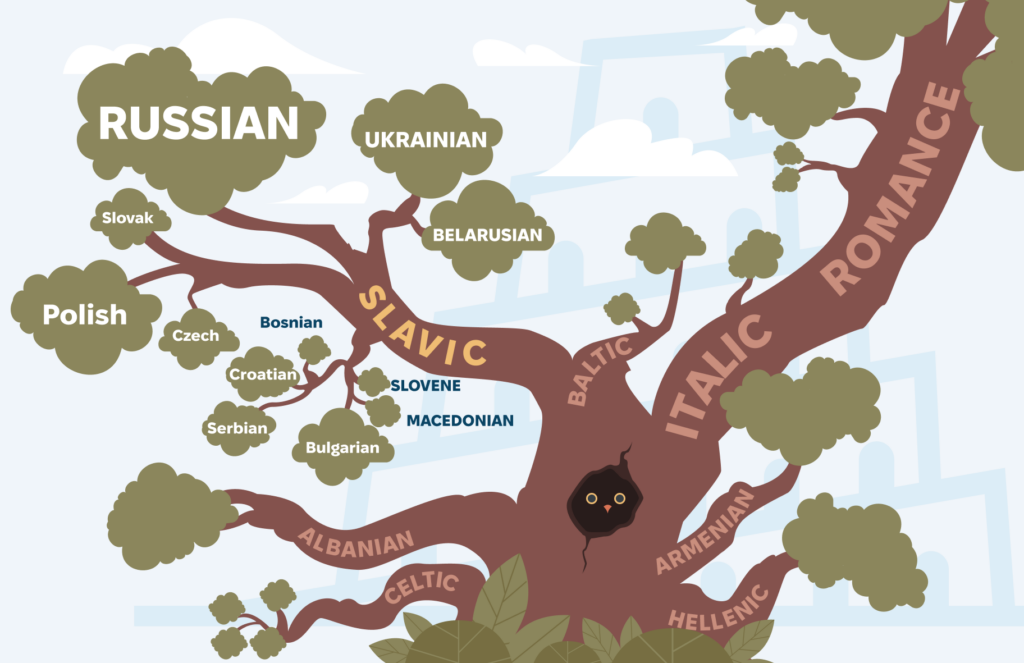
On this picture, you see Russian, Ukrainian and Belarusian on the same branch, and Ukrainian is put aside from Slovak and Polish. But this picture is closer to political narratives of Russia rather than to real linguistic facts.
In terms of vocabulary, Ukrainian and Russian are as distinct from each other as Italian and Portuguese. Please take a look at this map of lexical similarities among Slavic languages:
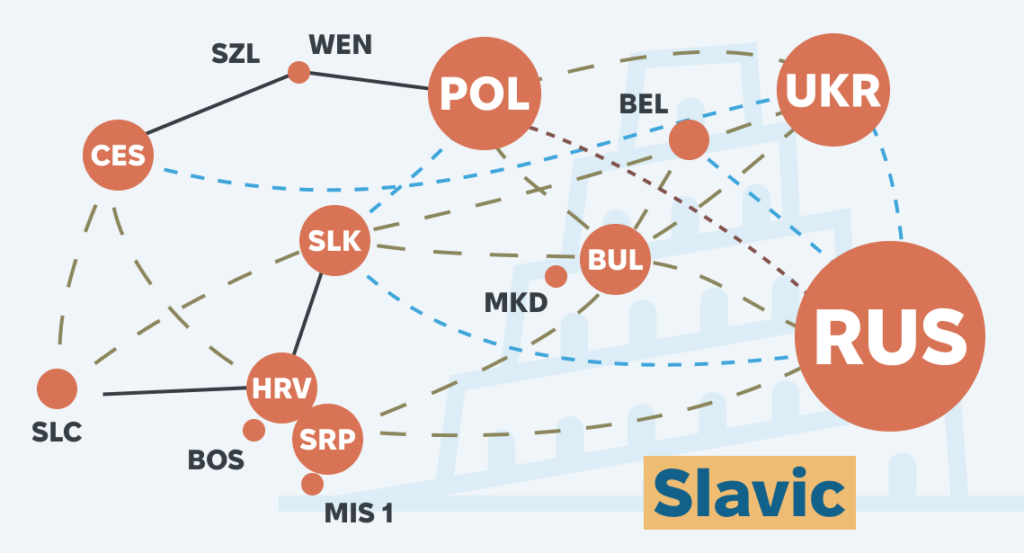
(Extended map may be found by this link.)
As you can see, the difference between Ukrainian and Russian is 38%. Ukrainian is much closer to Belarusian and is even mutually intelligible with it. Interestingly, even Polish and Slovak are closer to Ukrainian than Russian is. Surprisingly, the closest Slavic language to Russian is Bulgarian, not Ukrainian.
Historical reasons for linguistic differences
The reason for this linguistic divide lies in historical developments. The area of Moscow was not originally Slavic before the 11th century—it was populated by the Finnic tribe Merya. The Slavs who later settled there adopted the language primarily used by the clergy rather than the spoken language of the locals. This formal language was Church Slavonic, which was essentially Old Bulgarian. Later, Moscow remained under the control of the Golden Horde for centuries, during which Russian absorbed many Turkic words (e.g., dengi for “money”).
Meanwhile, Ukraine and Belarus were part of different political entities—first Kyivan Rus, then the Grand Duchy of Lithuania, and later the Polish-Lithuanian Commonwealth. This explains why Ukrainian and Belarusian remained closely related.
Russian and Ukrainian developed separately for hundreds of years, and in the 17th century, they were even more distinct than they are today. Ukrainians and Russians could not understand each other without translators.
The illusion of similarity
Nowadays, many Ukrainians speak Russian due to a history of colonization, which may create the illusion that the languages are similar. However, native Russian speakers often struggle to understand Ukrainian.
A personal anecdote illustrates this well: While visiting Cyprus, the author of this text was speaking Ukrainian with their spouse. A Russian family sitting nearby overheard the conversation and began discussing their ethnicity. They recognized that we were speaking a Slavic language but could not identify which one. Eventually, they concluded that we were Slovaks—never suspecting that we understood their conversation.
By contrast, during a visit to Slovakia, we experienced a hotel robbery. The police arrived, and we communicated with them in Ukrainian while they responded in Slovak. We understood each other quite well. Had we spoken Russian instead, communication would have been more difficult.
The myth of Ukrainian as an “Artificial language”
Over the past 200 years, the Russian Empire and later the Soviet Union attempted to bring Ukrainian closer to Russian. While these efforts had some influence, the languages remain distinct. Russian propaganda even claims that Ukrainian is an “artificial language”—an absurd notion.
Consider this: The most popular artificial language, Esperanto, has only about 100,000 speakers, all of whom learned it voluntarily. It is practically impossible to construct a language and make millions of people adopt it, especially when the majority of them are illiterate peasants, as was the case in previous centuries. Such an effort would require an unimaginable amount of resources.
Some historical facts also contradict this claim. The first Ukrainian dictionary was published in 1627, whereas the first Russian dictionary was released only in 1783—156 years later. Additionally, the Ukrainian dictionary contains approximately 256,000 words, while the Russian dictionary has a maximum of 200,000 words. These facts make the notion of Ukrainian being an “artificial” language even more ridiculous.
The future of the Ukrainian language
In modern Ukraine, many children are growing up without speaking or writing in Russian, and they may struggle to understand it. Therefore, if you want to communicate effectively with Ukrainians, using Russian is not the best choice. So translate into Ukrainian, not into Russian.
Recommended content

Translation vs. Transcription: What Is the Difference?

What Is Transliteration? How It Differs From Translation and Transcription

What Is a Lingua Franca? Meaning, Examples, and Common Uses
How Many Languages Are There in the World?