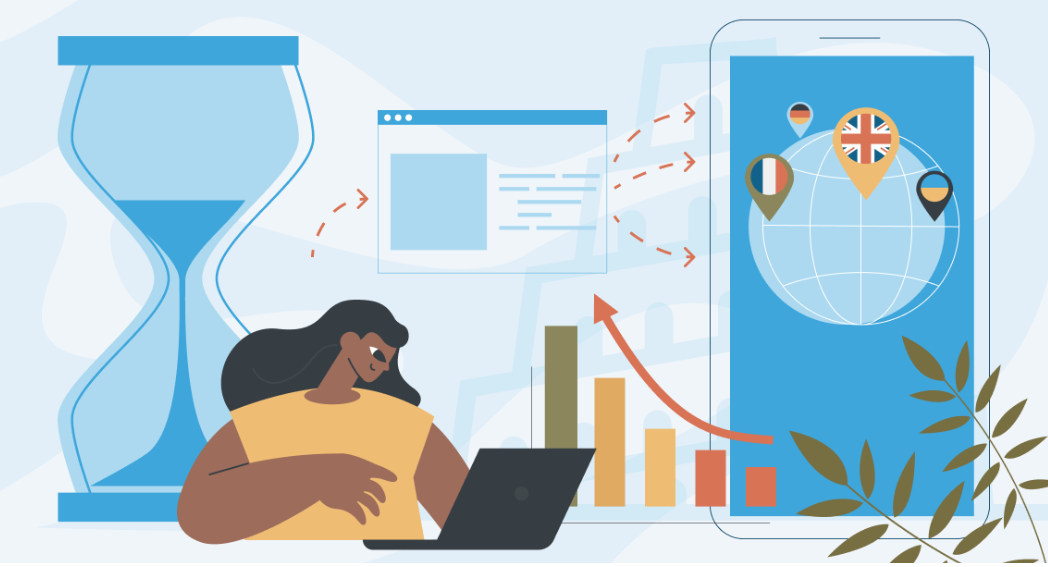
10 Questions to the Expert

Our production manager answered several questions from the students of Summer Translation School 2020, Diana Savostina and Viktoriia Pushina, and shared some ideas on the translation industry’s future:
How do you get new clients? How do you stand out from other translation companies?
The conventional answer to this question is that we stand out for the quality of our translations. But nowadays, high-quality translations no longer give you a competitive advantage: if you are a professional translator, you provide high-quality work by default; it is not even worth mentioning. You can no longer carve a niche through translation quality.
We get new clients by offering high-quality services. This is not the same thing. Translation agencies do not sell their clients a translation, but a service.
When you go to a restaurant, you don’t go only for the food. You go for the relaxing atmosphere, pleasant music, charming interior, and welcoming service. You are paying for the service. The food alone would cost much less. In just the same way, translation agencies are selling a service.
We respond to requests almost instantly, perform free tests, work speedily, and offer solutions to problems that have not yet even arisen. Since numerous of our clients are located in other countries and time zones, sometimes we work on weekends and at night. We can process non-standard file formats that other agencies reject.
In a word, our job is to make the client feel sure that the order will be ready in time and the whole process will be problem-free.
How much are translations in demand in Ukraine?
Ukraine has adopted the so-called Law on Language, which obliges every manufacturer importing products into the Ukrainian market to provide Ukrainian localization. This has led to an increase in our workload. On top of that, the translation market as a whole is growing at about 6% per year. This means that the demand for Ukrainian translations is growing, despite the coronavirus pandemic. We are finding that there are not enough qualified Ukrainian translators.
It should be borne in mind that in recent years, machine translation has become popular (which in fact should not be called translation, but this is another subject). Because of this, translators today are increasingly having to edit machine translations to make them more natural instead of performing translations from scratch. This is a whole other skill, which is called MTPE (machine translation post-editing), and there is even a separate ISO standard for it. The demand for translators who have post-editing skills is growing every year. A translator in today’s market should learn them.
What do translators need to know before starting work in a translation agency?
Based on my experience, I would say that the key quality in our business is the ability to learn and adapt. We live in a fast-changing world: It is impossible to base your entire career on a single skill. After 3–4 years, your knowledge will become obsolete.
There are translators at Technolex who were very knowledgeable when we hired them, but they are slow learners and are still at practically the same level. At the same time, many others barely managed to get through our hiring process intact, but who then studied hard and displayed an interest in every aspect of the business, and now they have become editors with a higher salary whom any manager would be glad to have in their team.
In our business, it is those people who possess an inquiring mind who achieve success, those who on their initiative take an interest in linguistic nuances, new program features, new products on the market, etc.
Who has the best chance of being hired by a translation company? What are the selection criteria?
I often have to assess tests. I don’t care whether the applicant has a form of philological qualification. Experience has taught me to focus on the applicant’s style and how they articulate their thoughts and construct sentences.
You can teach people to pay more attention to errors in spelling, punctuation, terminology, etc., and there is even a way to semi-automatically check these things. But it is much more difficult to teach people how to correctly articulate their thoughts. In other words, knowledge of the mother tongue is more important than knowledge of the foreign language. The paradox is as follows: students who are planning to become translators put in a lot of effort to learn English or German, but in practice, it is their mother tongue that becomes the main stumbling block for them.
To learn to clearly and correctly articulate sentences, you need to have a flair for your native language. You cannot develop this in a single year, and there is no “Guide to developing your flair for language.” People who are interested in language and who read a lot (and not Facebook posts, but intellectual books) develop this flair naturally. Such people can competently articulate their thoughts, without even being aware of where they have learned to do this.
However, getting hired by a company is only half the battle, because you still need to get through the trial period. Statistics show that a third of applicants do not pass this period. On the other hand, those who do are still working here at least three years later, and usually for much longer. Those who leave us usually move into another market—in other words, translators do not leave us for other agencies.
How can a novice translator who has no work experience find a job?
This is a common issue, and not only in the translation market. The newcomer is locked in a vicious circle: without experience, you cannot gain employment, and you cannot gain experience without employment. So to break this vicious circle, you need to gain whatever experience you can.
Watch instructional videos about linguistic subtleties, the nuances of your foreign language, and about computer programs used by translators. Subscribe to specialist channels and blogs. Join translation groups on social networks—let the regulars share their experience with you. Perform free translations to get an idea of what the work involves. Create a translation portfolio that you can show to potential employees. Analyze your mistakes. Take some translation tests. Do not worry if you fail a test: For example, in our company, no one is stopping you from taking tests several times.
How important for a translator is the ability to work in a team, or is translation an exclusively one-person job?
The profession of a technical translator is viewed as an ideal option for introverts. And we do have a lot of introverts at our company. But this is not a one-person job.
In Technolex, all translators are divided into teams, so the ability to work with others is more important than ever. When a large project hits the desk, everyone involved in it has to be in constant communication. For example, if you notice a term that your colleagues are translating incorrectly, you need to tell them about this and offer what you believe to be the best translation. The translation is delayed—you need to liaise with the manager. If you suspect an error in the source text—you need to write to the client. If you do not agree with the corrections made by an editor—you need to discuss them with them (we have implemented an entire system to do this). There are many situations in which you need to be in contact with other people.
Does a translator need to possess specific literary skills, or is knowledge of languages enough?
These two things are related. Anyone who works with texts one way or another acquires the ability to produce them, so usually, translators can easily turn their hand to things like copywriting and writing creative prose. Translators don’t formally need such skills, but in any case, writing and literary skills are a big plus.
Do translators need additional education to translate specialized texts?
Translators do not need official qualifications to work with us. However, some topics require specialist knowledge, such as medicine, jurisprudence, etc. Errors in such translations can be expensive, and so additional education is necessary for such subjects.
Since translation is essentially the transfer of meaning, our company is guided by the general principle: the translator must fully understand the text they are working on. But specialized texts are different.
We simply will not undertake the translation of a nuclear reactor operating manual—it cannot be done without the presence of a nuclear physicist. But we can easily translate car repair manuals, for example. Of course, the translator must understand how a car works and be able to distinguish the carburetor from the generator. But a formal technical qualification is not necessary for this purpose.
How, in your opinion, do “classic” translators differ from modern-day translators? When reading a text, is it possible to understand when it was translated?
Translators today spend much less time searching for the information they need than their predecessors (by the way, the ability to instantly find the required information is one of the essential skills of a modern-day translator). Translators today are much more efficient. They don’t have to spend hours waiting for the required manual in the library or wading through endless dictionaries. All this can be done on the computer, which greatly speeds up their work.
Now there is no such profession as just a translator, just as there is no such profession as just an engineer. This is too general a concept. Literary translation, technical translation, and simultaneous translation are practically different professions, despite the ubiquitous presence of the word “translation.”
The time a text was written can be roughly determined through corpus linguistics, by looking at the frequency of use of words—for example, using the national corpus of the Ukrainian language or the Google Ngram Viewer service. Or according to marker words—for example, if the text refers to Facebook, it is clear that it was written after 2004 since Facebook was founded in that year. Analyzing the style and manner of presentation can also give some clues. In Soviet times, for example, a great deal of attention was paid to ideology, even to the point that “improper” paragraphs or sections of a foreign book were sometimes cut out altogether because they did not agree with the “official” narrative. When you see a deeply ideological text, you know straight away that it was written in the USSR. In general, the language of translators has changed along with the language of the rest of society.
Will the profession of a translator be in demand in 5–10 years, or will machine translation completely supplant the human translator?
Since translation is the transfer of meaning, machine translation can replace a person only when the machine learns to understand the meaning of the human language. I don’t believe this is on the cards soon because even people often misunderstand each other.
Machine translation will certainly weed out translators from the market whose translations are no better than those performed by machines. The translator profession will see change, and in 5–10 years, translators will not so much translate but rather refine the work of machine translators.
Recommended content
Machine Translation vs. AI Translation: What’s the Difference?
Financial Translation: The Ultimate Guide

Translation Memory Explained: Everything You Need to Know

How Remote Interpretation Works: A Complete Guide for Businesses