Freelance or Ukrainian LSP Subcontractor?
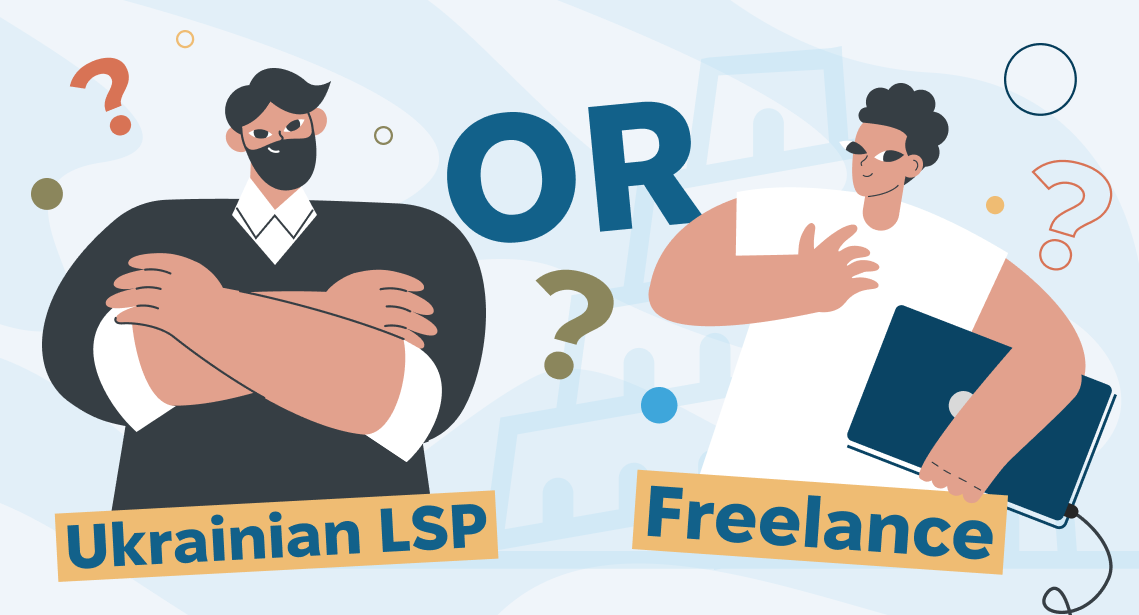
While attending conferences and talking to different language service providers (LSPs) in the U.S., we noticed that some translation agencies have a policy of working only with freelancers and do not consider subcontracting to an LSP from the country where the target language is spoken—for example, outsourcing translation into Ukrainian to a translation agency in Ukraine.
We asked about the reasons behind these policies and found both well-grounded arguments and misunderstandings. Let’s examine each of them.
Cost
This is the most common argument: a freelance translator is cheaper than a translation agency, right? On average, yes. However:
- It depends on the cost of living where the translator resides. For example, in Ukraine, the cost of living is 3–5 times lower, and salaries are at least 5 times lower than in the U.S., so it’s no surprise that a translator from Ukraine will charge less than a translator based in the U.S. Even a Ukrainian translation agency may charge less than a Ukrainian-speaking translator living in the U.S.
- Even in Ukraine, some translators establish a solid client base and charge American prices, making them as expensive as an LSP subcontractor.
Thus, an LSP from Ukraine may be just as affordable as a freelancer. But you might ask, “Why not just find a freelance translator in Ukraine?” You certainly can, but here’s the catch:
- You won’t be able to reach most potential freelance subcontractors. They don’t know about you, and you won’t be posting ads in Ukrainian on specialized portals or visiting them in person.
- How do you assess their qualifications if you don’t speak Ukrainian? At the very least, you’ll need someone to evaluate their skills and oversee quality control until you’re confident in their work. Even for an LSP finding qualified resources is a challenge, but that’s the job they do for you.
- Many good Ukrainian translators are working in-house in Translation agencies.
Additionally, keep in mind that an LSP (translation agency) does much more than just translate. In fact, the agency itself doesn’t do the translating—the work is done by professional translators. However, the LSP handles:
- Vendor management: Screening and assessing candidates, training them to work on translation projects, and ensuring quality control.
- Quality assurance: Translation, editing, and quality checks before delivering the final product.
- Project management: Coordinating large projects, distributing work among translators, and ensuring deadlines are met—saving you hours of management time and stress. Especially in bigger projects when a team of translators and proofreader is needed.
A good LSP provides much more value for the same price. So, if cost is your only concern, talk to an LSP—you may find that their rates are not as high as you expect and that they offer many benefits you hadn’t considered.
Time zone and response time
If you’re in the U.S. (especially on the West Coast) and your potential vendor is in Ukraine, you might worry about communication delays since their workday may end just as yours begins.
Yes, this can be an issue if you need immediate responses to every message. However, many projects take days to complete, and if you have a reliable supplier who consistently accepts your jobs, this shouldn’t be a problem. In fact, it can even be an advantage:
- You send your files at the end of your workday, and they may be ready by the next morning, as the team in Ukraine will work while most people in the U.S. sleep.
- Late-hour availability can often be negotiated if you have enough ongoing work to keep them busy.
Conclusion
Ultimately, working with a Ukrainian LSP can be a cost-effective and efficient solution. If you’re concerned about pricing, communication, or response time, a conversation with an LSP may clarify things more than you expect. Just talk to them and see.
Recommended content

What Is Transliteration? How It Differs From Translation and Transcription
What Is a Lingua Franca? Meaning, Examples, and Common Uses
How Many Languages Are There in the World?
What Is a Language Family? Major Language Families Explained