MTPE Cost Misuse in the Industry

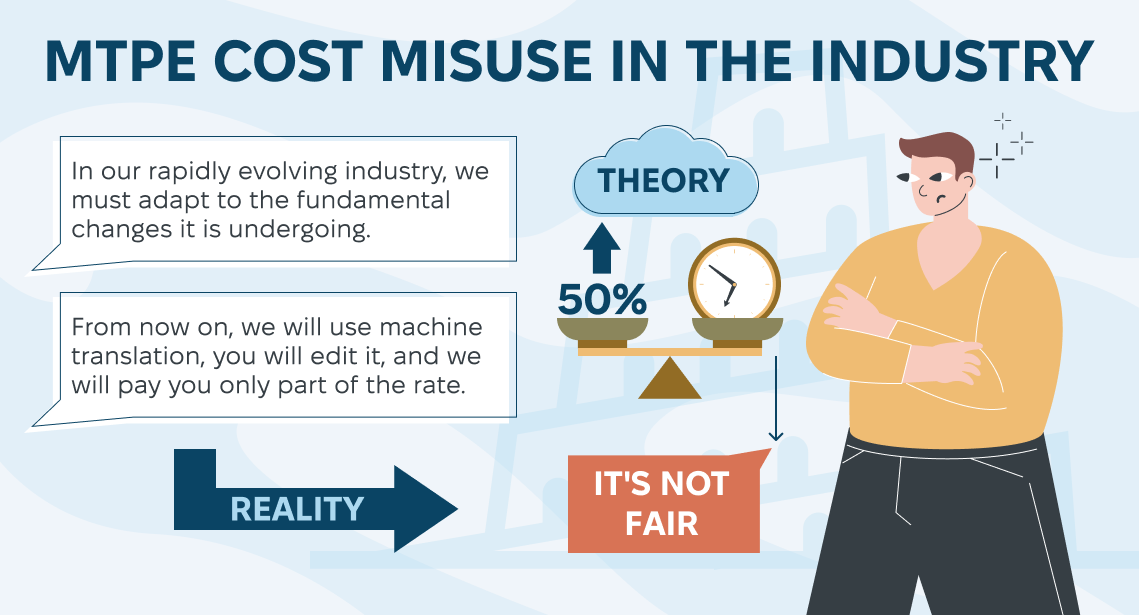
We all know that nothing good follows when a client sends a message like this when ordering translations: “In our rapidly evolving industry, we must adapt to the fundamental changes it is undergoing…”
What comes next is usually a long message that can be summarized as: “From now on, we will use machine translation, you will edit it, and we will pay you only part of the rate we used to pay for translation.”
Often, this is presented in a tone that does not invite discussion. So, what is the real problem here?
Theory from an ideal world
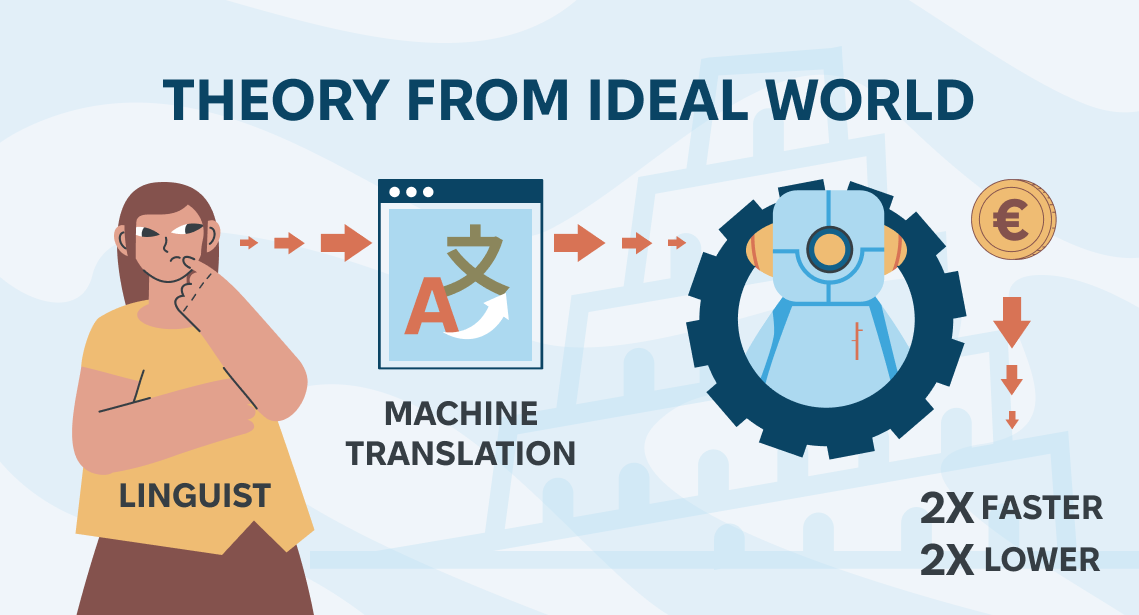
Let’s acknowledge the fact: machine translation (MT) can now deliver acceptable results. Not perfect, as it still needs to be checked and edited. The theory is simple: if post-editing MT allows work to proceed twice as fast as human translation with the same result, then it makes sense to use it. Translate twice as fast, reduce the rate by half, and the linguist ends up earning the same amount per hour. Sounds good.
So why do most linguists grimace at such proposals? Is it because they are resistant to change? Some may be, but that’s not the main issue.
Reality check
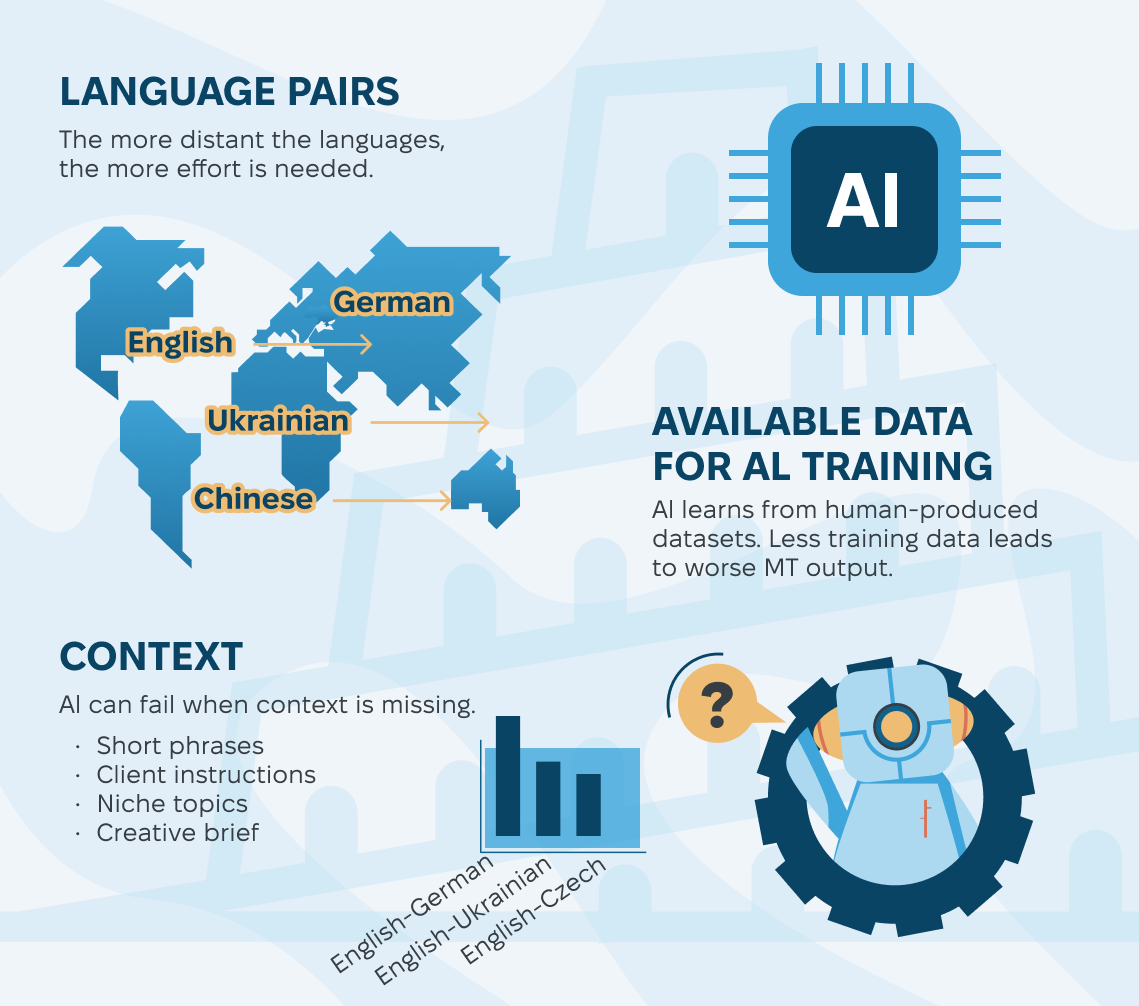
The problem with this rate suggestion is that it is often pulled out of thin air. It is based on assumptions that haven’t been tested or proven. A supposed 100% productivity gain is not always achievable. The real gain depends on many factors, such as:
Language pairs. The more distant are the languages, the more effort is needed. What works well for English to German performs worse for English to Ukrainian, and even worse for English to Chinese. That’s because English and German are both Germanic languages, Ukrainian is a Slavic language (but from Indo-European family like English), and Chinese comes from a completely different language family. These linguistic systems developed independently and have different worldviews, making alignment challenging.
Available data for AI training. AI learns from human-produced datasets. It’s similar to how humans learn, only much faster. But if the training data contains mistakes, the AI replicates them. That’s why MT always needs human oversight.
Moreover, not all language pairs have sufficient data. There is a lot of English-German content, less for English-Ukrainian, and almost nothing for most languages in Papua New Guinea. Less training data leads to worse MT output, which then takes more effort to edit.
Context. AI can fail when context is missing. It struggles with short phrases or ignores instructions from the client. It might perform poorly with niche topics it hasn’t been trained on. And if the brief says “be creative,” even a human may misinterpret it, let alone AI. In such cases, the text often needs complete rewriting, and MT becomes a hindrance.
Money matters
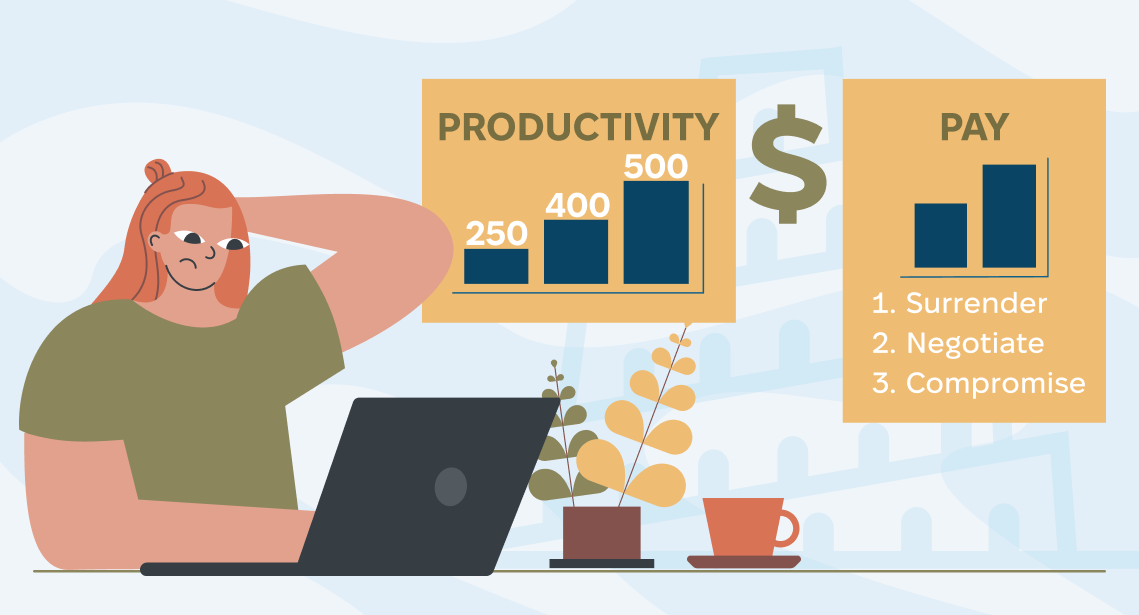
All of the above can lead to lower productivity than the client expects. For example, a translator who normally translates 250 words of English to Ukrainian marketing content per hour gets an MT draft and is expected to edit 500 words per hour. But due to the poor quality of the draft, they only manage 400 words per hour to maintain the same standard. That’s still more than 250, but here’s the problem: they get paid as if they translated only 200 words in an hour, not 250. So they earn less and naturally feel frustrated.
At that point, the translator faces a choice:
- Surrender—accept the lower income
- Negotiate—try to explain this to the client
- Compromise—meet the volume expectations and let quality suffer
The situation becomes more complex when a large multilingual vendor (MLV) subcontracts MTPE work to a single-language vendor (SLV), who then hires a freelance translator. For example, MLV says, “We’ll now pay 50%,” but SLV knows that maintaining the same quality requires at least 70% of efforts. They try to negotiate but get a 200-words windy “no,” and realize they must now deliver the project with only 50% of the original budget. So what options do they have?
- Push the cut down the chain. Forward the same “we must adapt” message to the translator. Risky, as many linguists may simply walk away. So SLVs often try to offer a more reasonable 70% rate. But then how do they cover the remaining 20% gap?
- Set new productivity standards. Tell the linguist directly — the client pays for 500 words per hour, so that’s the target. Yes, it risks quality, but the rules weren’t made by us. Cross your fingers and hope for the best.
- Skip some steps in the workflow. Replace human proofreading with automated QA tools. And again, cross fingers.
Bitter aftermath
What happens next? Sometimes nothing. The client stays happy, so quality expectations are met, more or less.
But often, it turns out differently. The MLV’s QA team or the end client finds issues and sends complaints. SLV replies, “We warned you,” but this rarely changes anything. The client responds, “You accepted the terms. And the quality expectations remain unchanged.”
That’s not how it works. You can’t cut costs without consequences. It's a universal rule, like gravity. If you demand the same quality for less money, it’s not fair — it’s cheating. And everyone knows it.
A fair approach
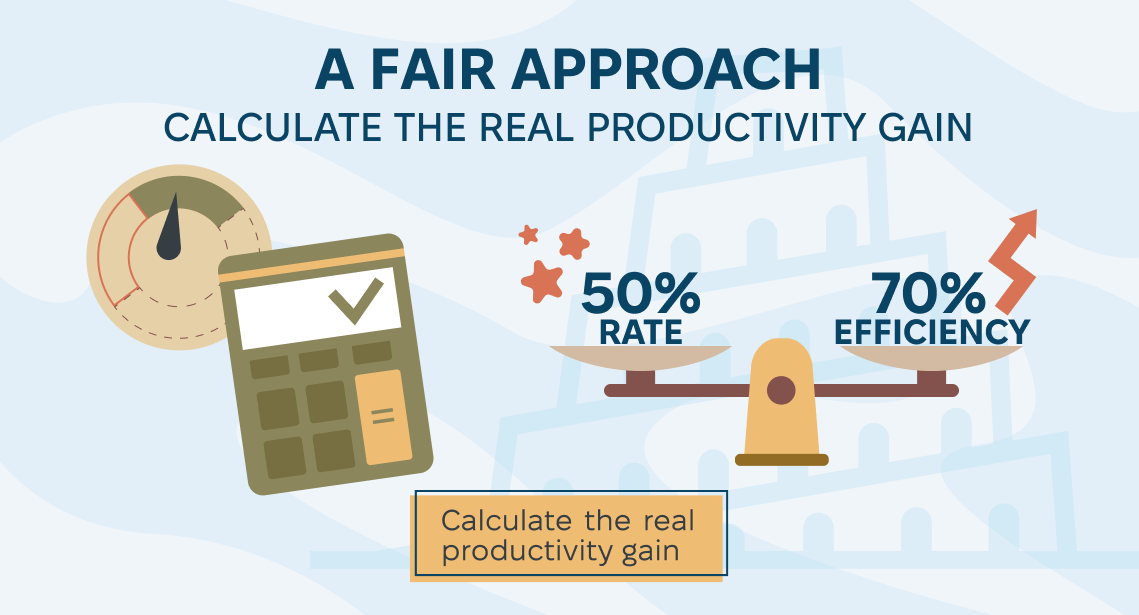
The way to avoid this situation is simple: calculate the real productivity gain. If a linguist can truly work twice as fast with MT and maintain the same quality, then a 50% rate is fine. But if they can only reach 70% efficiency, then the rate should reflect a 30% discount, not 50%.
This needs to be determined for every language pair, subject, and project type. Ignoring this leads either to dissatisfied linguists or to damaged quality.
Recommended content

How to Run a Tender for Ukrainian Translation Services

How to Localize E-commerce Product Descriptions to Boost Global Conversion Rates
Translation vs. Transcription: What Is the Difference?

What Is Transliteration? How It Differs From Translation and Transcription