Freelancing: How to Manage Clients, Deadlines, and Payments

Freelancing is often not taken seriously and considered to be a side job; an additional source of money on top of a main salary, or a temporary cash aid until a full-time job is found.
Working as a freelancer is the format of a fully-fledged professional activity. A real freelancer is a self-employed entrepreneur. Freelancing is the job and the business. The only difference with other businesses is that a freelancer is a “one-man band”: he or she is a manager, vendor, seller, marketer, and accountant all in one.
A freelancer’s success depends on their ability to perform all of these functions proficiently. Even a very good translator is unlikely to be successful as a freelancer, without good presentation skills and abilities to keep records of orders and payments, send invoices to clients on time, schedule jobs, and adhere to clients’ policies.
In this article, we’ll tell you how to manage your business effectively.
Don't play a double game
Many translators would like to get into freelancing but are afraid of leaving a full-time job, even though it dissatisfies them. Their earnings are insufficient, so they moonlight. However, if you’re employed full-time, you don't have time for meaningful freelancing work: having worked full-time, you won’t be able to work properly for another 2–4 hours per day. Such a combination of jobs can’t last long, and being exhausted by this moonlighting for a month or two, the only thing you will want to do is rest.
Sooner or later you will have to make a choice: to find a full-time job that suits you—without spending nights on a side job, or to completely get into freelancing and become self-employed. Taking freelance jobs as a side project, you won’t make great progress.
Now that I am my own master, what's next?
It’s been said that freelancers don’t have a boss. This is far from the truth: they are their own bosses. So if a boss fails, things are not going too well. It’s no easier managing yourself than it is to manage others.
Becoming a freelancer, you stop being exclusively a translator and instead transform into a “one-man band”: you’ll have to constantly switch between a marketer, seller, accountant, and manager, and do it all in the right order.
- As a marketer, you’ll have to write a presentable resume and create profiles on translation marketplaces. It’s recommended you create a professional blog or website, and regularly post there any information that may draw potential clients’ attention and demonstrate that you’re in line with market trends.
- As a seller, you’ll have to find leads, communicate with them, and prove your competence. You’ll probably need the materials that you have prepared as a marketer. In addition to this, you’ll need to respond to clients quickly and offer solutions for their problems.
- As an accountant, you’ll have to invoice clients; track and record payments; chase up arrears from non-payers, if any; pay taxes; etc.
- As a manager, you’ll have to analyze your results, build plans, and set the work direction of a marketer and seller. What’s more, it’ll be your responsibility to control the vendor’s discipline.
- As a vendor, you’ll have to execute your work expertly; otherwise, the rest of your roles will have nothing to do.
Consequently, freelancing is a business, and business requires clear systems and accounting. To guide your business, you will need some tools.
What are the tools
Level 1—to keep everything in mind
All relevant information can theoretically be kept in one’s mind. For example, to remember that you need to write an article for a blog and send a cooperation offer to three companies, create invoices for five clients, not forget about the intermediate deadline for a current order, also deal with a non-payer, and find a month-old file for a client.
It will be very easy to miss something using this system. Furthermore, it’s better to spend your brain capabilities on more relevant jobs: why load it with something easy to automate?
Level 2—tables, folders, schedulers, mail
You can record all orders in an Excel or Google Docs file, store them in a self-made structure, track deadlines via a scheduler, create invoices in Word, and record terms and payments in a separate table.
The problem is that this will need a fair amount of self-discipline. You’ll have to manage it hand to hand: create separate files for each task, remember to make notes in a table, and copy files in proper folders manually. Reporting becomes complicated with this approach.
Level 3—functional systems for freelancers
There are plenty of systems that allow you to unite and organize all aspects of a freelancer’s professional activity. Moreover, some of them are developed specifically for translators. E.g., Plunet, XTRF, TO3000, TranslationProjex, QuaHill, Protemos.
Each of these systems has its advantages and disadvantages. You can explore their cost and functionality and choose the most suitable one. We will focus on a free and simple solution: Protemos.
Functions
Protemos is an online service (SaaS) developed for translation companies and freelance translators.
The system was released in May 2016 in two versions—for translation agencies, and freelancers. For the latter, developers decided to make it free.
The system allows you to:
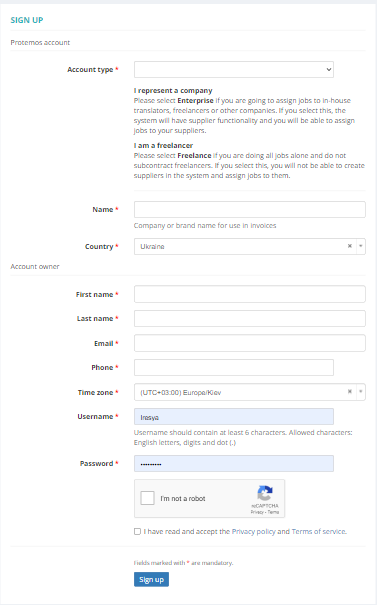
- Create an account quickly. You don’t need to install any programs, contact the support team, or pay for a license. It takes five minutes to get started. You just need to fill in some standard fields.
- Store all your client’s data (potential, as well as active): contacts, prices, and payment terms.
- Create projects for actual and potential orders: specify which client made this order, the job price, and the deadline.
- Store project-related files.
- Generate quotations and invoices automatically: send them to clients directly from the system.
- Record payments made by clients and track both arrears and their amounts at any time.
- Generate statistics per client and order: see how your earnings changed monthly, which clients generate the most revenue, what are their quoting and payment dynamics, etc.
- Export all spreadsheets in Excel and process them if needed.
Using this system, you’ll streamline these activities and therefore free lots of time for translations, as well as improve the work efficiency of your ‘internal experts’—the marketer, seller, accountant, and manager. They’ll appreciate it, and your business will stop being a black box that is too complicated even for you!
Remember that this system is free for freelancers. If your business reaches a level that requires engaging your colleagues to perform jobs and giving them tasks, you’ll be able to easily update the system to the Enterprise version for agencies.
In addition, developers collect feedback from users, so that Protemos can match your expectations as much as possible. They will be grateful for your ideas.
You can learn more about Protemos on their website and Facebook page. Moreover, you can watch a video tutorial or download a Freelancer’s Quick Start Guide.
Recommended content

Website Translation Explained: Methods, Tools, and Best Practices for Global Success

Clinical Trial Translation: Why Accuracy is a Matter of Life and Death

High-Context vs. Low-Context Cultures: Advanced Marketing Strategies for Global Brands

How to Adapt Tone of Voice (ToV) When Translating Marketing Copy from English to Ukrainian