Translation Quality Assurance Tools
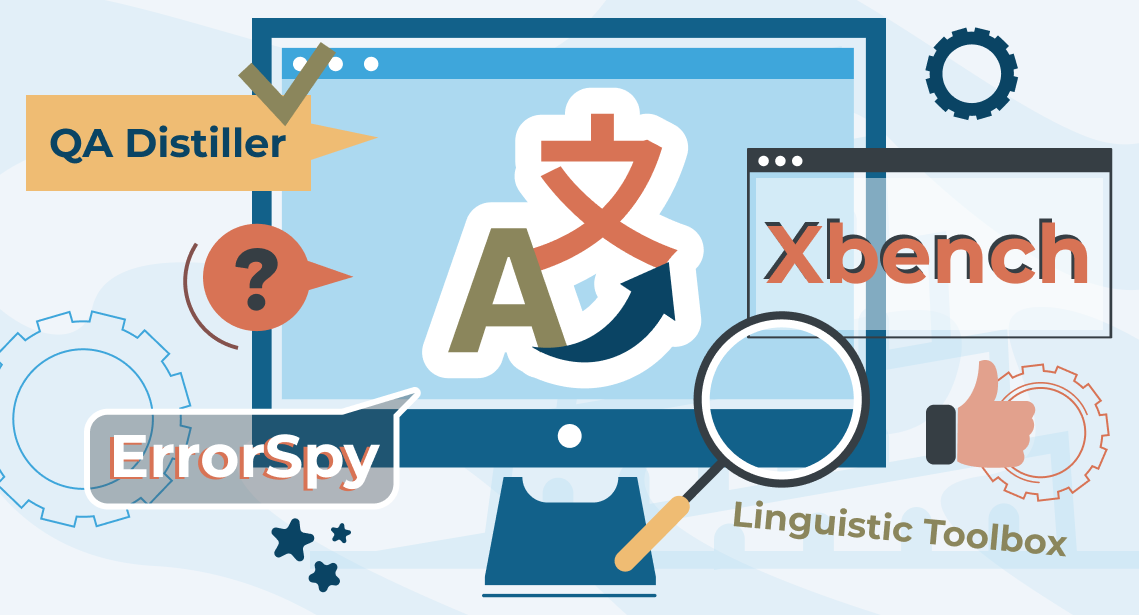
In this article, we will talk about the tools used by translators, editors, and managers of translation agencies, for translation quality assurance. We will review their functions, their strengths, and limitations, as well as common misconceptions about their efficiency
How it works
Software products, for translation quality assurance purposes, are tools that assist in identifying common mistakes found in translated texts, using formal attributes. They work only with bilingual files that are created in professional translation software. The quality assurance (QA) software analyzes the source and target text of a specific sentence or paragraph and records all the suspicious segments in a special report. The user then decides whether those segments contain mistakes or not.
Examples of mistakes detected by such systems:
- The source and target text have different ending punctuation marks, upper/lower case letters, or formatting tags.
- The target text contains double spaces, spaces before punctuation marks, trailing spaces, etc.
- Incorrect decimal separators, measurement units, etc.
- The source text has abbreviations, while the target text does not (or vice versa).
- The same source segments are translated differently or, vice versa: the same translation is used for different source segments.
- The target text is much shorter or longer than the source text.
- There are untranslated segments or non-segmented text.
- The translated term does not match the one in the glossary.
- There are opening brackets without the corresponding closing brackets, incorrect quotation marks in the target text, etc.
- Spelling mistakes.
As we can see, these are mainly the barely noticeable typos. Even professional translators can make such mistakes due to a lack of thorough attention. To look for such mistakes manually is a time-consuming task, whereas the QA software detects them immediately and without a hitch. That’s why, both translators and editors are recommended to run their texts through quality assurance systems: this will reduce the probability of negative feedback from their clients.
By entrusting these technical matters to the software, translators, and/or editors, can focus on more creative tasks, i.e. translation accuracy and text quality.
Popular translation quality assurance software
Today, the most popular QA tools are:
Each of the above QA software works with bilingual files, in various formats, and most of the standard checks performed by them are similar. However, each of these tools has its unique functions. For instance, Xbench allows offline search of a text in project—both in the source material and target text—and online search.
In addition to QA software tools, a person can use their glossaries, check criteria, or disable unnecessary functions, thus creating an optimal configuration for either checking a specific project or for an individual’s general requirements.
Some of this software is only available commercially, however, many programs offer a free version. It’s worth noting, though, that the user interface in those tools can look very different. Therefore, each professional translator can select the most convenient, or appropriate, option, or even several options.
Many developers of software for computer-aided translation, including Trados, SDLX, Star Transit, Wordfast, Déjà Vu, memoQ, and others, have included automatic QA functions that can be configured, and in the case of memoQ, the created configuration settings can be saved to run checks in a project at the user’s discretion. As a result, the translator can run several checks without using external QA software.
Some translation agencies develop their additional tools for quality assurance, and all the above-mentioned popular QA tools were initially created by translation agencies for their internal use and were only later released as commercial products. However, many such internal developments were not released, and are instead used exclusively by individual translation agencies.
In addition, there are online services for checking the quality of translated texts, using SaaS (Software as a Service) principles. One of these is called lexiqa. Usually, such systems emerge as a translation agency internal solution, i.e. as a by-product in addition to the main business. Only afterward, having been refined, and passing its quality control checks, are they released as a separate product. But in this particular case, the developer worked exclusively on one product. Even the current version allows running basic checks. The system is developed quickly, and the developer actively cooperates with translation agencies and implements their suggestions.
TQAuditor
Another solution on the market is a translation quality monitoring system called TQAuditor. It is also intended for translation quality assurance, but performs a slightly different task: it is designed not to detect mistakes, but for translators to analyze an editor’s corrections, and learn from mistakes. For instance, TQAuditor compares different versions of bilingual files and generates a report about the corrections implemented into a text. Such a report creates numerous opportunities for translators, editors, and managers. For example, editors can look through their corrections before delivering a text, and make sure they have not made any mistakes. Managers can provide a report with corrections to a translator for educational purposes, etc. Usually, this tool is used as part of the QA software applications mentioned above.
An enterprise version of TQAuditor lets translation agencies classify mistakes made by translators by type and gravity, as well as evaluate the translation quality quantitatively. The translator and the editor can discuss controversial points, and even submit them to an arbiter. All data is compiled into a single database used for the generation of reports on the quality of work for each translator. This enables finding weak spots in them individually and identifying the areas requiring particular attention: grammar, punctuation, style, etc. Therefore, this system contributes to the professional growth of translators as a skilled workforce. Similar reports are also generated for each editor. One benefit is they allow the identification of ‘strict’ and ‘soft’ editors, i.e. those who make many and few corrections in a text, accordingly. In the Enterprise version of TQAuditor, this information is presented in a visually convenient graphical form.
Weak spots
As mentioned above, no software can replace a professional editor: it can only facilitate the editor’s work, allowing a person not to overuse their eyes searching for important but hardly noticeable mistakes, such as unnecessary space before a period.
Software is a robot that does not analyze the text sense. That’s why, the fact a QA tool has not found any mistakes, by no means guarantees the translation is correct. If a translator writes a word salad but complies with the formal requirements, the software will not detect any mistakes even if the text has phrases such as:
“Our reputation is taller than the others’, and operational personals are increasing each year!”
In addition, sometimes the translation quality assurance systems produce many false positives: there are cases where more than 90% of segments that software detected as suspicious, contained no mistakes. On the other hand, translators or editors can decide on their own which checks are efficient and what checks should be disabled.
Clients, who do not always speak the same language, and who rely upon the “power” of QA software, often confound the situation. Clients may require the sending of a QA report with detailed explanations of why a certain “mistake” in the text was not corrected. As a result, the translator has to spend time explaining to the client the grammar rules of a particular language, and much effort is spent on just convincing the client that there are no mistakes (we have a separate article about such a situation). That’s why all the translation process stakeholders need to understand clearly when QA tools genuinely help to increase the translation quality, and when they just become part of a pointless bureaucracy, wasting people's efforts, time, and money.
It is worth mentioning that in today’s globalized economy, it is difficult to imagine modern technical translations without QA software, such as CAT tools, but these are not very practical in terms of literary translation.
Conclusion
While at the current stage of scientific and technical progress, no quality assurance software can successfully replace a professional editor; their use eases part of an editor’s tasks and increases the text quality. There are many tools currently available, and each professional linguist or translation agency can find the tool that is most suitable for them. However, a competent expert should determine the suitability and the procedure for using such software applications, or they may become just a bureaucratic formality, wasting the time of all translation process stakeholders.
Recommended content

What Is Transliteration? How It Differs From Translation and Transcription

What Is a Lingua Franca? Meaning, Examples, and Common Uses
How Many Languages Are There in the World?
What Is a Language Family? Major Language Families Explained