Translation vs. Transcription: What Is the Difference?
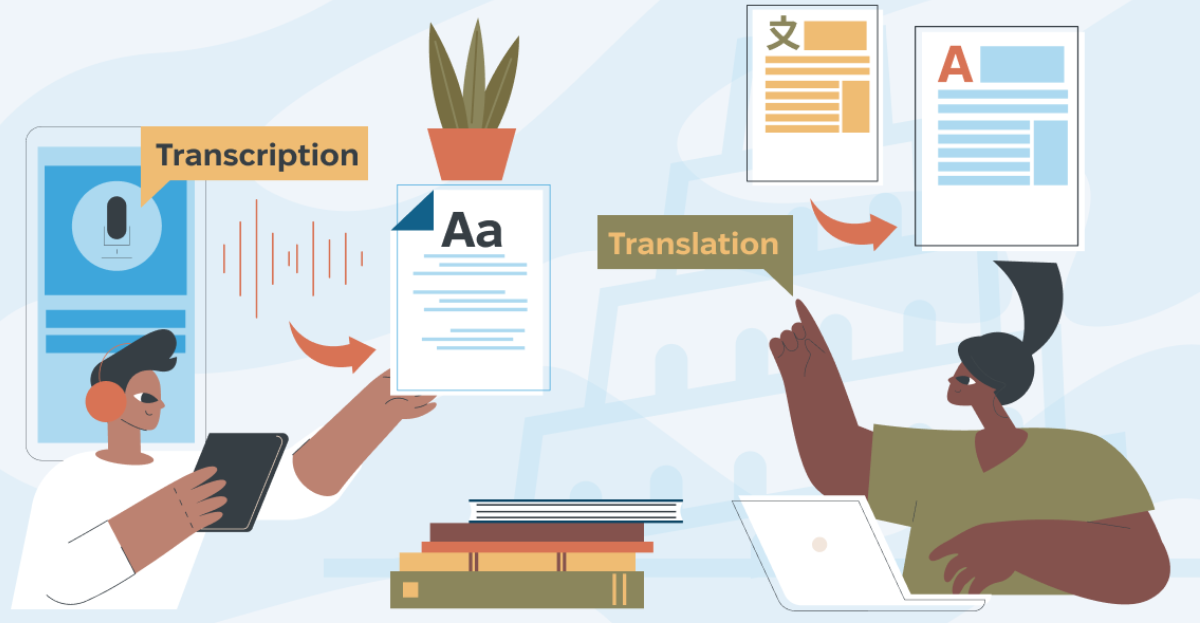
Translation and transcription are often mentioned together, especially when a project involves interviews, webinars, podcasts, or video content. Both are language services, and both can be part of the same workflow. Yet the actual work they perform is quite different.
The simplest way to understand the distinction is to focus on what happens to the original content. Transcription turns speech into written text, while translation transfers a message from one language to another while preserving its meaning and purpose.
That difference matters when choosing a service. A recorded interview might only need a transcript, while a multilingual video may require transcription, translation, and subtitles. Knowing what the project needs from the outset makes it easier to choose the right process and avoid unnecessary work.
What transcription is
In simple terms, transcription is the process of listening to spoken content and producing a written version of it. The language usually stays the same—only the format changes.
Let’s imagine a company recording an hour-long interview in English. A transcriptionist listens to the recording and produces an English transcript. Nothing is translated; instead, spoken content becomes searchable, editable, and easier to review.
The level of detail can vary based on your needs:
- Verbatim transcription: includes every sound, such as repetitions, unfinished sentences, filler words (“like,” “um,” “uh,” etc.), stutters, and other features of natural speech. This is highly valued in legal proceedings and qualitative psychological research.
- Clean read (non-verbatim): removes some of those elements to make the text easier to read without changing the meaning of the speaker’s words.
Depending on the project, the transcript may also include speaker tracking (names of speakers), timestamps, indications of pauses, and other relevant sounds.
What translation is
Unlike transcription, translation involves a change of language. A translator takes a source-language message and expresses it in a target language while preserving the intended meaning, tone, and context. An English software guide translated into Ukrainian is a great example—the information stays the same, but Ukrainian-speaking users receive the instructions in their own language.
Good translation is not simply a matter of replacing words. Languages structure ideas differently, and an expression that sounds natural in one language may sound awkward when translated literally. A professional translator therefore considers terminology, sentence structure, cultural references, tone, and the expectations of the target audience.
This is especially important in business and marketing content. A website translation, for instance, has to do more than reproduce the dictionary meaning of each sentence. Product descriptions, navigation labels, calls to action, and brand messaging all need to sound natural to people reading them in the target language.
Translation vs. transcription
The transcription and translation comparison becomes much clearer when the two services are placed side by side.
| Feature | Transcription | Translation |
| Main purpose | Turn speech into written text | Transfer meaning into another language |
| Source material | Usually audio or video | Written, spoken, or multimedia content |
| Language | Usually remains unchanged | Changes from source to target language |
| Typical output | Transcript | Translated content |
| Main challenge | Accurately capturing what was said | Conveying meaning naturally and accurately |
| Common applications | Interviews, meetings, podcasts, research | Websites, documents, software, marketing, legal and medical content |
While distinct in their core mechanics, these two services sometimes can complement each other in broader content strategies.
When you may need both transcription and translation
Transcription and translation services often fit together when spoken content needs to reach an audience that does not speak the original language.
Suppose an international company conducts customer interviews in Germany. The recordings are in German, but the research team working on the results speaks English. A German transcript makes the interviews easier to search and review, but it does not remove the language barrier. English translation makes the content accessible, while the source transcript can still be useful for checking the original wording.
A combined workflow can solve both problems:
- Transcription: The German recording is converted into a German transcript.
- Translation: The transcript is translated from German into English.
- Review and formatting: The final material is checked and prepared for its intended use.
This transcription translation process is useful because each stage has a clear purpose: the source transcript provides a written record of the original conversation, while the translation makes the content accessible to the wider team.
This workflow can be used for documentaries, market research, training materials, video interviews, podcasts, and other multilingual content. For instance, a production team may transcribe interviews for editing, translate selected sections for an international release, and then use the translated text to create subtitles.
Technology can automate parts of the process, particularly when the audio is clear and the subject matter is straightforward. Speech recognition is able to produce a first-pass transcript, and machine translation can create a draft in the target language. Human review remains important when the material contains specialist terminology, unclear audio, sensitive information, or wording where a small error could affect the meaning.
Which service you need
The easiest way to choose between translation and transcription is to consider the final result you need rather than the file itself.
If you have a recording and need a written version in the same language, transcription is the relevant service. If you already have content in one language and need it for readers who speak another, translation is what you need. When the source is spoken and the final output must be in another language, both services may be required.
Consider an interview conducted in French for an English-speaking research team. The team may want a French transcript for reference and an English version for analysis. In that situation, transcription and translation serve different purposes within the same project.
The choice can also depend on how the content will be used. A legal or research project may prioritize an accurate record of the original speech, while marketing content may require a more natural target-language copy, brand voice, and cultural context.
Conclusion
The difference between translation and transcription comes down to two basic operations: transcription changes speech into text, while translation changes one language into another. They serve different purposes, but both can easily become part of the same workflow. An interview, webinar, documentary, or customer conversation may need to be transcribed before it is translated, edited, or turned into subtitles. In other cases, transcription alone is enough because the audience already understands the original language.
When deciding which service you need, start with the end goal: are you trying to create a written record of what was said, make existing content available in another language, or do both? Once that is clear, the choice between transcription, translation, and a combination of the two becomes much easier.
Recommended content

What Is Transliteration? How It Differs From Translation and Transcription

What Is a Lingua Franca? Meaning, Examples, and Common Uses
How Many Languages Are There in the World?
What Is a Language Family? Major Language Families Explained