Ukrainian Names and Toponyms Translation into English, and Why It Matters
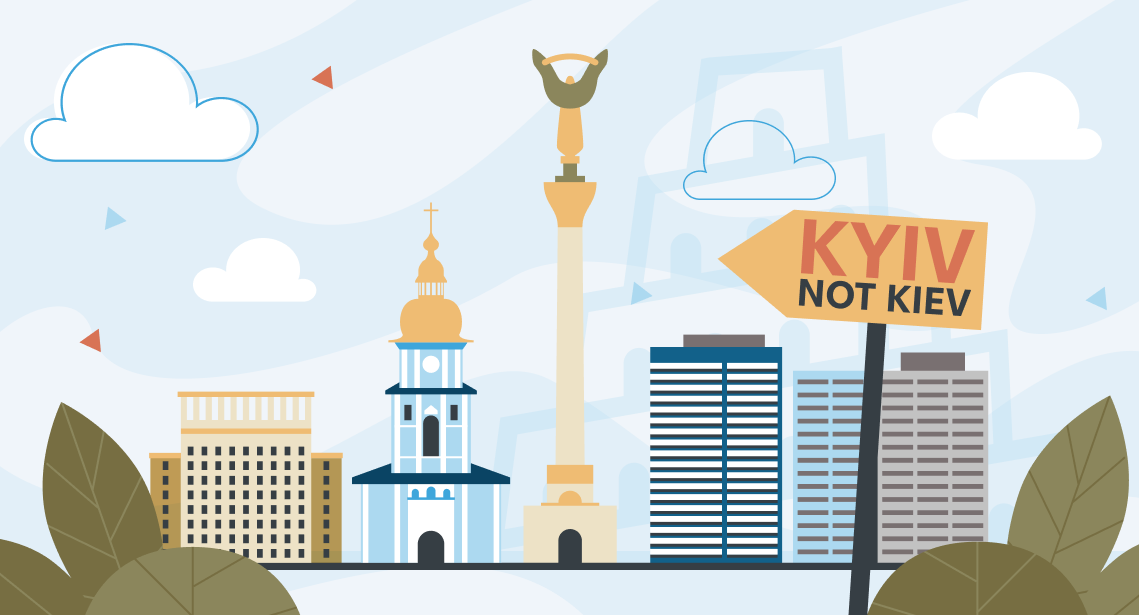
Language is more than a communication tool. It’s a vessel of culture, identity, and history. This is especially true for Ukraine, whose names and toponyms (place names) carry deep cultural significance. However, due to centuries of Russian colonization, many Ukrainian names were distorted through imposed Russified forms that eventually found their way into English and other languages. As a result, names in Ukrainian often sound and look completely different from their English versions. Today, as Ukraine asserts its identity and sovereignty, correcting the English translation of Ukrainian names is not just a linguistic detail, nor is it about how to pronounce Ukrainian names. It is a matter of national dignity and historical justice.
A legacy of russification
For hundreds of years, the Russian Empire, and later the Soviet Union systematically imposed Russian-language standards on all aspects of public and private life in Ukraine. Ukrainian names of people and cities were routinely translated, replaced or “adapted” to fit Russian phonetics and spelling. As a result, these Russified versions became the standard transliterations used internationally.
This is how Ukraine’s capital, Kyiv, became widely known as Kiev, derived not from Ukrainian “Київ” but from Russian “Киев.” Similarly, the Ukrainian name Volodymyr was rendered as Vladimir, Mykolaiv as Nikolayev, and Odesa was often written as Odessa. Some names are hardly recognizable, like Mykola—Nikolay, Mykyta—Nikita. The problem is that these forms do not reflect the Ukrainian language, they reflect the colonizer’s language, imposed through decades of cultural dominance.
The power of names
Names are not neutral. They shape how people and countries are perceived. Using Russian-based spellings reinforces outdated narratives that Ukraine’s identity is secondary or derivative of Russia’s. Conversely, using correct Ukrainian transliterations signals respect for Ukraine’s independence and its right to self-identification.
When international media, institutions, and individuals adopt the correct spelling (Kyiv instead of Kiev, Kharkiv instead of Kharkov, Dnipro instead of Dnepropetrovsk), they affirm Ukraine’s sovereignty linguistically as well as politically. Each corrected name is a small act of decolonization, an acknowledgment that Ukrainian culture and language exist independently of Russian influence.
Volodymyr, not Vladimir, even history proves it
The distinction between Volodymyr and Vladimir perfectly illustrates how historical Ukrainian names were Russified. The medieval ruler known in English as Volodymyr the Great, the Christianizer of Kyivan Rus, bore the Ukrainian name Volodymyr (Володимир), not Vladimir. This name was later distorted under Russian influence, even though the original form predates the emergence of the Russian language itself.
Interestingly, modern Russian preserves traces of that older Ukrainian form: the diminutive version of Vladimir is Volodya, not “Vladya.” This linguistic fact alone suggests which version is historically more authentic and ancient. The contrast between Volodymyr Zelensky and Vladimir Putin today symbolically reflects more than just two individuals; it highlights the cultural and linguistic divergence between Ukraine and Russia, and the importance of using each nation’s true names.
There are many similar examples. In the Russian Orthodox Church, priests still bear the so-called “traditional” names Oleksii and Serhii, not Alexei or Sergey. These are, in fact, the older Ukrainian forms of the names, which preserve the original, more ancient pronunciation.
A hidden problem: outdated software and user interfaces
Despite the growing awareness, many global software systems and user interfaces still rely on outdated databases or legacy code that contain Russian transliterations of Ukrainian cities. From airline booking systems and delivery platforms to GPS applications and customer databases, users often encounter “Kiev” instead of “Kyiv” or “Odessa” instead of “Odesa.” These outdated UI components may seem like minor technical artifacts, but they perpetuate colonial-era distortions in everyday digital communication.
Correcting them is not merely a cosmetic update, it’s a necessary modernization that reflects geopolitical reality and cultural accuracy. Global tech companies, localization teams, and data managers should prioritize updating their location databases and language packs according to Ukraine’s official transliteration standards.
Official rules for transliteration from Ukrainian to English
To standardize this process, the Cabinet of Ministers of Ukraine has approved official transliteration rules that define how Ukrainian names and toponyms should be rendered in English. These rules are publicly available and form the legal basis for correct international usage (see official document).
The system is consistent, transparent, and based directly on Ukrainian phonetics rather than Russian intermediaries. For example:
- Г → H (as in Hryhorii, not Grigory)
- Х → Kh (as in Kharkiv, not Harkov)
- И → Y (as in Kyiv, not Kiev)
These rules ensure that English transliterations reflect authentic Ukrainian pronunciation and identity, aligning with international standards and diplomatic usage.
Why it matters
At first glance, changing a few letters might seem minor. But in reality, it’s about rewriting history correctly. Each corrected spelling represents a conscious rejection of linguistic colonization and a reaffirmation of national integrity. It ensures that Ukraine speaks to the world in its own voice, not through the filtered echo of a foreign empire.
In an era when language is a battleground for truth and identity, using Kyiv instead of Kiev is not just correct. It’s right.
Recommended content

What Is Internationalization (i18n)? A Practical Guide for Global Products

Website Translation Explained: Methods, Tools, and Best Practices for Global Success

Clinical Trial Translation: Why Accuracy is a Matter of Life and Death

High-Context vs. Low-Context Cultures: Advanced Marketing Strategies for Global Brands