Difference Between the Language Codes and the Country Ones
When working with digital content, websites, software, or localization projects, you will often encounter various codes that represent languages, countries, or both. These codes are essential for ensuring that users see content in the correct language and region. However, many people confuse language codes with country codes, which can lead to errors in websites, apps, or databases. Understanding the difference between these codes is crucial for developers, translators, and content managers.
What are language codes
Language codes are standardized abbreviations used to represent specific spoken languages. They are defined by the ISO 639 language codes standard, which ensures consistency across systems. Language codes are typically two or three letters long, and they allow computers to identify and display content in the correct language.
Some common examples of language codes include:
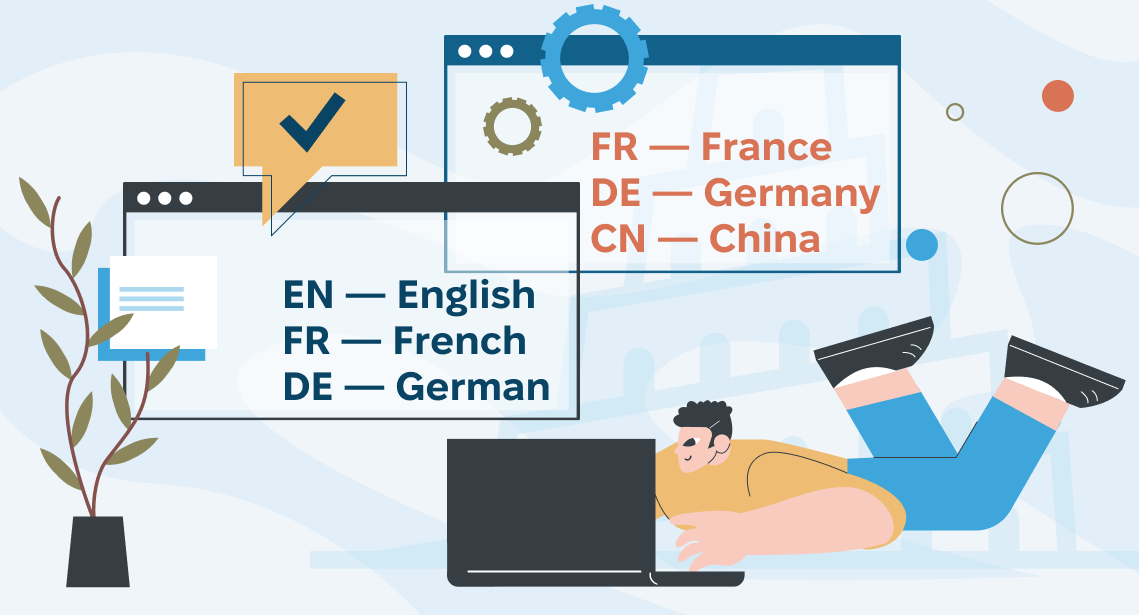
- EN — English
- FR — French
- DE — German
- ES — Spanish
- UK — Ukrainian
- ZH — Chinese
Language codes are often used in locale identifiers or language locale codes, which combine both a language and a country code to specify a language variant. For example, EN-US represents American English, while EN-GB represents British English. Using language codes correctly ensures that users see content in their preferred language.
Language codes are not just for websites. They are widely used in software localization, translation management systems, mobile apps, and even in video subtitles. If you have ever selected a language from a dropdown menu on a website, you have interacted with ISO 639 language codes.
What are country codes
Country codes represent countries or regions. They are standardized by ISO 3166, also known as ISO 3166-1. Country codes help systems identify geographical areas, for example, for shipping, localization, or legal purposes. Unlike language codes, which refer to what people speak, country codes refer to where they are located.
Common examples of country codes include:
- US — United States
- GB — Great Britain
- UA — Ukraine
- FR — France
- DE — Germany
- CN — China
- JP — Japan
Country codes are widely used in internationalized domain names (such as .uk, .ua, .fr), car registration plates, international bank account numbers (IBAN), and mobile phone dialing codes. They are also crucial in creating language and country combinations, which we will discuss below.
Key differences between language codes and country ones
While both language codes and country codes are short abbreviations, their purposes are different:
| Aspect | Language Codes | Country Codes |
| Represents | Spoken language | Country or region |
| Example | EN (English), UK (Ukrainian) | US (United States), UA (Ukraine) |
| Usage | Website language, software, translation | Domain codes, shipping, and locale identifiers |
| Standard | ISO 639 | ISO 3166 |
| Possible variants | Yes—like EN-US, EN-GB | No—fixed country identifiers |
One of the most confusing examples in Ukraine is the code UK. In language codes, UK represents Ukrainian. But in country codes, the UK represents the United Kingdom, not Ukraine. This illustrates why understanding the distinction is critical when using language locale codes or locale identifiers in digital projects.
How language and country combinations work
Many systems use both language and country codes together to specify the exact language variant. These are known as locale identifiers. The format is usually <language>-<country>.
Examples:
- EN-US — English as spoken in the United States
- EN-GB — English as spoken in Great Britain
- UK-UA — Ukrainian as spoken in Ukraine
- FR-CA — French as spoken in Canada
- ES-MX — Spanish as spoken in Mexico
This combination allows software to differentiate between dialects, spelling variations, and region-specific content. For instance, EN-US uses “color,” while EN-GB uses “colour.” Without proper language and country combinations, users might see unfamiliar spellings, formats, or content.
Why does it matter:
- Helps avoid confusion between similar languages or dialects
- Ensures correct date, time, and number formatting
- Improves user experience in apps and websites
- Prevents SEO issues, as search engines may treat content differently for different regions
Common mistakes when using language and country codes
Many mistakes occur when using language codes and country codes, often because of their similar appearance or because users are unaware of the standards.
- Confusing UK and UA: As mentioned, UK is the language code for Ukrainian, while UA is the country code for Ukraine. Mixing them up can break URLs or localization settings.
- Using a country code instead of a language code: For example, setting content to US instead of EN-US may confuse the system because US is a country, not a language. Correct usage is EN-US.
- Forgetting language and country combinations: Some websites only use EN or FR without specifying the country, which may result in displaying the wrong dialect or format for the user.
- Incorrect casing: ISO standards recommend using uppercase for country codes (US, GB) and lowercase for language codes (en, uk). Writing EN-us is technically incorrect.
- Overcomplicating codes: Adding extra codes or mixing multiple standards can confuse systems and developers.
Understanding these common mistakes is essential for localization and content management. Following ISO 639 language codes and ISO 3166 country codes ensures consistency and reduces errors.
When to use only language codes and country ones
Knowing what language codes are and what country codes are helps you decide which to use in different situations.
Use only language codes when:
- Content is general and not region-specific
- You want to support a language across multiple countries
- Example: EN for English content that applies globally
Use country codes when:
- You need to specify a region or country
- Content has country-specific formatting (dates, currencies, addresses)
- Example: EN-US vs. EN-GB for English, FR-CA for French in Canada
Best practice: Use language and country combinations whenever you need both language and region specificity. This ensures clarity for both users and systems. It is essential in localization projects, translation software, and websites targeting multiple countries.
Final thoughts
Understanding the difference between language codes and country codes is essential for anyone involved in digital content, software, or localization. Language codes, defined by ISO 639, represent spoken languages, while country codes, defined by ISO 3166 or ISO 3166-1, represent countries or regions. Using these codes correctly prevents confusion, improves user experience, and ensures your content appears correctly for your audience.
By following best practices, avoiding common mistakes, and using language and country combinations like EN-US, EN-GB, or UK-UA, you can ensure smooth localization and proper internationalization of your digital projects. Remember: understanding what does EN-US mean and similar codes is the first step toward successful global content delivery.
Recommended content

What Is Transliteration? How It Differs From Translation and Transcription

What Is a Lingua Franca? Meaning, Examples, and Common Uses
How Many Languages Are There in the World?
What Is a Language Family? Major Language Families Explained