Translation vs. Localization vs. Transcreation: What’s the Real Difference?
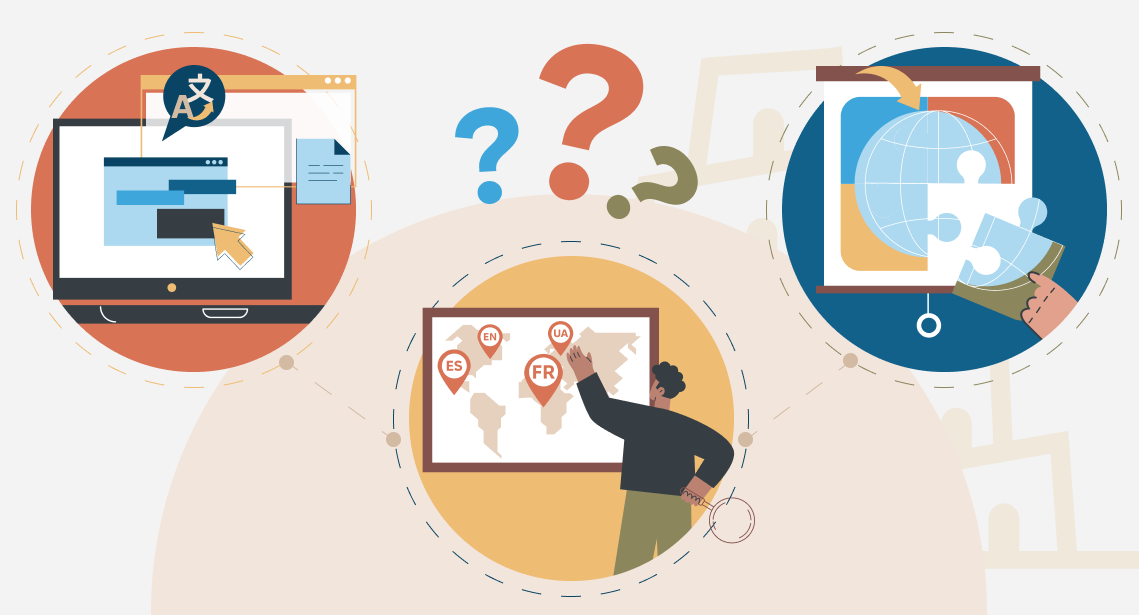
Translation, localization, and transcreation are three terms widely used in the translation industry and represent three ways in which content can be made available to a foreign audience. They are related to each other but are not the same thing. If you want to translate a piece of content, an app, or a website for your services into other languages so that they are accessible to a new market, one of these approaches may be more suitable for you than the others. Let’s explore the fundamental differences between localization and translation, the meaning of transcreation, and which option best suits your business goals.
What is translation
A simple definition of translation is the process and result of rendering a text from one language (the source language) into another (the target language) so that its speakers can understand the information. Translators break linguistic barriers between languages and cultures.
Since the same text cannot be identical in two languages (even very closely related ones) translators have to consider the type of text, the context, and the client’s requirements to understand what should be preserved above all else.
Think of a medical instruction. When dealing with such sensitive information, a translator must render every scientific term precisely and ensure equivalence between the two texts. On the other hand, when it comes to poetry, a literal translation often makes little sense, and the translator may significantly change the original text in order to preserve rhyme and rhythm.
Today, the translation industry offers a wide variety of services and tools suitable for different text types and purposes.
- Goal: To convey the meaning of the source text from one language into another, preserving as many stylistic and extralinguistic nuances as possible, and to create a coherent, grammatically correct, and clear target text.
- Optimal for: Any type of text where preserving the message is crucial, such as technical texts, scientific, legal, and medical materials.
What is localization in translation
Now let’s look at the difference between translation and localization. Localization is the process and result of adapting a product or service so that it can be used by speakers of the target language as if it were local. This usually involves both the translation of textual content and the adaptation of non-textual elements, date formats, currencies, units of measurement, and more.
Unlike translation localization is a more comprehensive process that requires in-depth knowledge of the target country, its culture, customs, practices, and even laws. Localization of user interfaces, apps, and websites may also include technical adjustments to ensure the correct display of localized elements.
For example, a text translated from English into German or French can expand by 20–40%. To make such text fit into UI elements like buttons or menu items, it is often necessary to adjust the wording throughout the interface.
Another common challenge involves cultural superstitions and taboos. While in Western cultures there are superstitions associated with the number 13, in East Asia the number 4 is considered unlucky. It is important to consider these mindset differences in order to avoid negative associations.
- Goal: To adapt content to both the target language and culture.
- Optimal for: Digital content intended for end users, such as software, web pages, and video games. Mobile application localization is particularly challenging because UI space is limited due to screen size, so translations must be not only accurate but also concise. Localization can also include multimedia content that is dubbed or captioned for users from different cultural backgrounds.
Localization vs. translation
| Translation | Localization |
| Changes words into another language | Makes content feel local |
| Mostly keeps the original wording | Adjusts wording to sound natural |
| Same message everywhere | Message adapted for each country |
| Images stay the same | Images may be changed |
| Good for understanding text | Good for selling and user experience |
What is transcreation
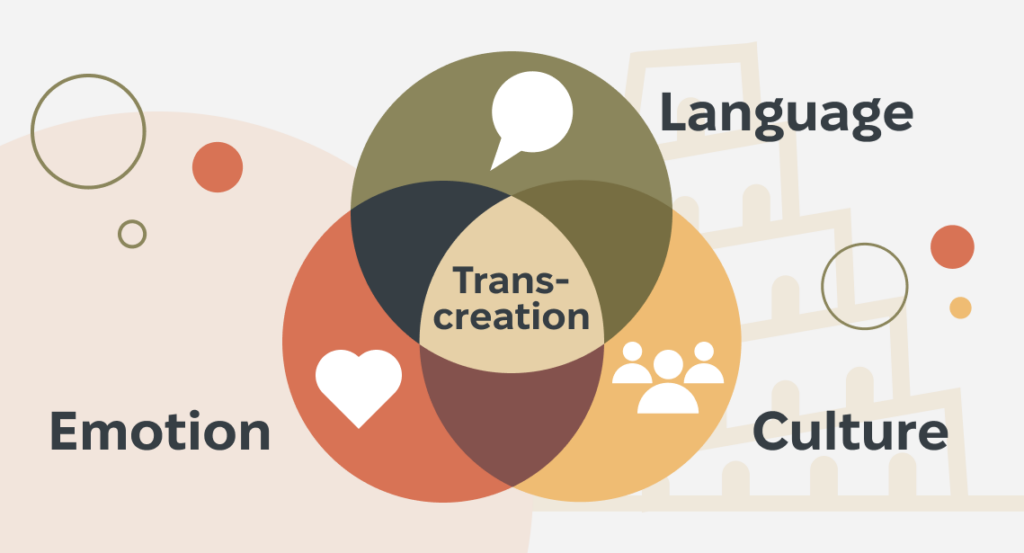
Transcreation is a relatively new term, and to define transcreation, you should think more about creation than translation in its direct meaning. Conveying the original idea is more important than preserving the exact wording. That is why this approach often results in a text that sounds completely different from the original.
You have probably seen some well-known examples of transcreated slogans:
- McDonald’s “I’m lovin’ it” transcreated into French as “Come as you are”
- Toyota’s “Let’s Go Places” transcreated into Japanese as “Anytime, anywhere, GO”
- Airbnb’s “Belong Anywhere” transcreated into French as “Feel at home everywhere”
- Swiffer’s slogan “When Swiffer’s the one, consider it done” successfully adapted into Italian as “La polvere non dura, perché Swiffer la cattura” (“Dust doesn’t last, because Swiffer catches it”), preserving the catchy rhyme
- Intel’s slogan “Intel: Sponsors of Tomorrow” transcreated into Brazilian Portuguese as “Intel: In Love with the Future”
We already know that many words and expressions in one language can sound anything from neutral to provocative in another language. This can be caused by double meanings of certain words or by cultural associations linked to specific objects and concepts.
This automatically means that a text in one language will never evoke exactly the same emotions in another language. But does this make it impossible to recreate the same emotional response? No. It simply requires using the rich expressive means of the target language rather than relying on the original form of the text.
In transcreation projects, translators often work closely with product developers and marketing teams to find the best solution that supports business objectives.
- Goal: To preserve the original message of the text without necessarily keeping its original form, and to ensure the intended perception by the target audience. Unlike transcreation translation does not always evoke the same emotions, especially in texts where the literal meaning must remain unchanged.
- Optimal for: Transcreation is a perfect approach for texts whose main purpose is to appeal to the audience’s emotions, such as marketing materials, advertisements, and brand slogans.
Transcreation vs. localization
| Transcreation | Localization |
| Rewrites the message creatively | Adapts existing content |
| Focuses on emotions and impact | Focuses on local fit |
| Message may change a lot | Message stays mostly the same |
| Common in ads and slogans | Common in products and websites |
| Prioritizes effect over accuracy | Prioritizes clarity and usability |
Key differences (comparison table)
Below is a comparison of translation, localization, and transcreation across different aspects to help you decide which approach best suits your business and project:
| Aspect | Translation | Localization | Transcreation |
| Purpose | Accurately convey the original meaning in another language | Adapt content to meet linguistic, cultural, and market expectations | Recreate the intended emotional and persuasive impact |
| Applications | Legal, technical, and informational material | Software, websites, games etc. | Advertising, branding, and creative material |
| Literal meaning | Strictly preserved with minimal deviation | Preserved where possible, adjusted where necessary | Secondary to intent and effect; may be substantially altered |
| Creativity level | Limited | Moderate | High |
| Skills needed | Strong language proficiency | Linguistic expertise combined with cultural and domain knowledge | Advanced copywriting skills and marketing knowledge |
| Cost | Generally the most cost-effective option | Mid-range due to added adaptation work | Highest, reflecting creative and strategic effort |
Which approach to choose for your content
This is not an easy question to answer. Usually, it depends on several factors, such as your business goals, the type of product or service you offer, and the type of content you work with. Here is some advice to keep in mind when creating your internationalization strategy:
- If you have content aimed at engaging the audience and creating an emotional impact, such as social media campaigns, transcreation is the right choice, as it can be an effective first step in familiarizing your audience with your brand.
- If you are already familiar with the market and are launching a product in new regions (such as software or a mobile app) you should consider localization services to ensure everything works smoothly and your brand is not compromised.
- Each type of work requires a different turnaround time. Transcreation may take longer because it is a more creative process.
- It is crucial to consider your budget. Localization and transcreation may cost more due to the level of effort involved and the number of specialists required. Localization often requires cultural and technical expertise, while transcreation relies heavily on marketing and copywriting skills.
Final thoughts
When choosing between these approaches, it is just as important to understand the needs and specifics of your business as it is to understand the needs and specifics of the target locale. In some cases, these approaches should be combined to effectively enter a new market and reach the right audience.
Whether your goal is to inform, engage, or build a strong brand presence, one of these approaches (or a combination of them) can help you communicate effectively with audiences around the globe.
Recommended content

Adapting International Brand Names and Slogans into Ukrainian

The Most Popular Localization Languages

Tips for Translating Multimedia Content Without Losing Tone or Humor
Glossary Creation for Translation Projects: Why It Matters