12 Types of Translation
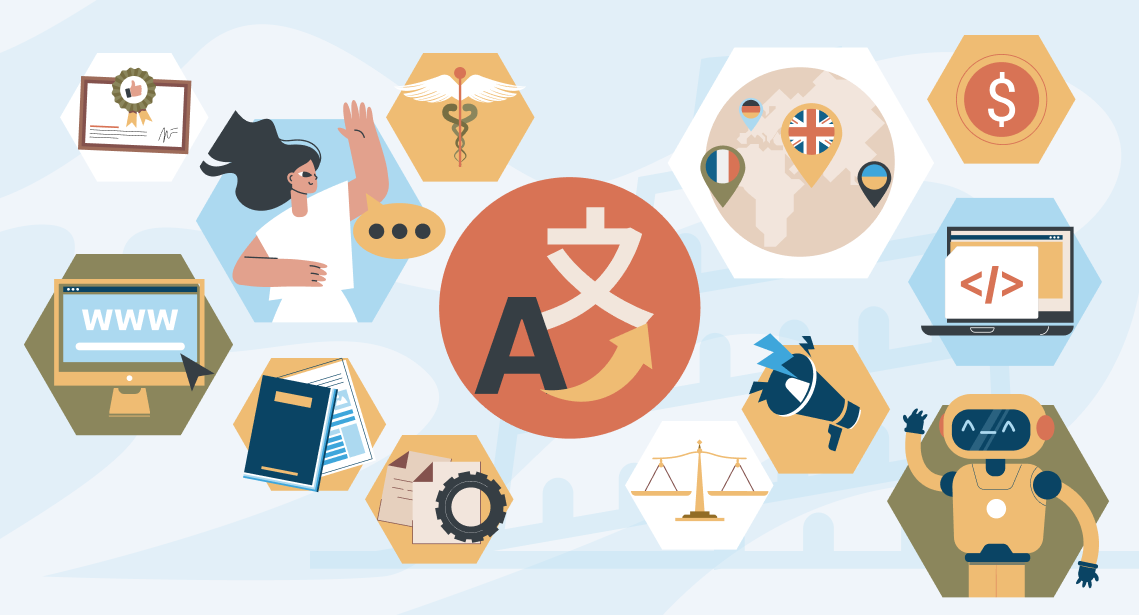
Translation is far more than swapping words between languages. At its core, it is about meaning—preserving intent, cultural resonance, and communicative purpose across linguistic boundaries. Whether you are a business entering a new market, a legal firm handling cross-border contracts, or a healthcare organization reaching multilingual patients, understanding the types of translations available is one of the most practical decisions you can make before starting any project.
This guide walks through the 12 most common fields of translation, explains what makes each one distinct, and helps you identify which translation services best fit your needs. Different translators are not created equal—and neither are all texts. And yet, that distinction gets ignored more often than you might expect.
Main types of translation services
Different industries demand different translation strategies, different tools, and different levels of expertise. What works for a marketing campaign will almost certainly fall short for a clinical trial document. Below is a breakdown of the most important types of language translation in use today.
1. Technical translation
Technical translation covers specialized content such as engineering manuals, API documentation, user guides, and product specifications. Accuracy is non-negotiable here—a mistranslated instruction in a machinery manual could result in equipment failure or physical harm.
Translators in this field combine principles of translation in linguistics with subject-matter expertise, often working with terminology management systems and glossaries to ensure consistency across large document sets. Common use cases include:
- Software and hardware documentation
- Engineering and manufacturing specifications
- IT and cybersecurity content
2. Medical translation
Medical translation is one of the most highly regulated areas in the entire industry. It covers clinical trial protocols, pharmaceutical labeling, patient information leaflets, and healthcare records. Inaccurate translations in this domain can have life-or-death consequences. Medical translators must understand regulatory frameworks such as those set by the FDA or EMA, and human expertise remains irreplaceable here even as machine translation improves.
3. Legal translation
Legal translation deals with contracts, court rulings, immigration documents, and regulatory filings. It requires preserving not just meaning but also legal intent and structure—because even a subtle difference in wording can alter the effect of a clause. It is also highly sensitive to jurisdictional differences: a term with a specific legal meaning in one country may have no equivalent in another. Certified or sworn translations are legally mandated in many jurisdictions.
4. Financial translation
Financial translation handles annual reports, audit documents, investment materials, and insurance policies. Numerical accuracy is paramount—a misplaced decimal can have serious consequences for investors and stakeholders. Translators must be comfortable with financial terminology across different accounting standards and understand how fiscal terms vary across markets.
5. Website translation
Website translation involves adapting online content—product pages, landing pages, blogs, and e-commerce listings—for different languages and regions. It is one of the most in-demand translation services today, particularly for businesses expanding into global markets.
It almost always goes hand in hand with localization: adapting not just the text but layout, images, currency formats, and tone to suit local audiences. SEO considerations also come into play, since keywords in one language do not always map to the most-searched terms in another.
6. Software translation
Software translation, also called software localization, focuses on adapting applications, platforms, and digital products for new language markets. It goes beyond translating on-screen text—it involves UI strings, error messages, tooltips, notifications, and help documentation.
You also must account for technical constraints like character limits, text expansion (many languages require more space than English), and right-to-left script support, which means that translators and engineers must work closely together.
7. Marketing translation
Known as transcreation, this approach shifts away from literal translation meaning in favor of emotional impact. A tagline that resonates powerfully in English may fall completely flat when translated word-for-word into another language. Marketing translators adapt tone, style, and cultural references to ensure the message lands with the target audience in the same way the original was intended.
This type of translation requires a strong creative sensibility alongside linguistic skill. It is common in advertising, social media, brand messaging, and promotional campaigns. The goal is not faithfulness to the source text—it is effectiveness in the target market. That is a fundamentally different objective, and it requires translators with a very different skill set.
8. Literary translation
Literary translation covers books, short stories, poetry, and screenplays. It is perhaps the most interpretive of all translation types, requiring different translators to balance fidelity to the original with producing text that reads naturally in the target language. Preserving metaphors, maintaining narrative voice, and capturing the rhythm of prose or verse are among the core challenges.
9. Certified translation
Certified translation is a specialized form of document translation required for official purposes, accompanied by a signed statement attesting that the translation is accurate and complete. It is commonly required by government agencies, courts, universities, and immigration authorities for documents such as birth certificates, diplomas, and passports.
10. Interpretation
Although not a written form, interpretation belongs among the types of translation that professionals must understand. Interpreters convert spoken language in real time—simultaneously (as the speaker talks) or consecutively (after the speaker pauses). Simultaneous interpretation is used in international conferences and diplomatic meetings; consecutive interpretation is more common in legal proceedings, medical consultations, and business negotiations.
11. Machine translation (MT)
Machine translation uses AI-driven systems to generate translations automatically, without human involvement. For large volumes of low-risk content—internal communications, user-generated content, or bulk website material—MT can offer high cost and time savings. However, it still struggles with cultural nuance and domain-specific terminology. Post-editing by a human translator is often necessary to bring MT output up to a publishable standard.
12. Localization
Localization is the broadest and most comprehensive type on this list. Localization goes beyond translating text to adapt the entire product or content experience for a specific market—visual design, date and currency formats, cultural references, imagery, and even color choices. For global brands, localization is not optional: it is the difference between content that feels native and content that feels foreign.
Comparison table: types of translation at a glance
The table below summarizes the key characteristics of each translation type to help you quickly identify the right approach for your project.
| Type | Key focus | Typical use case | Complexity |
|---|---|---|---|
| Technical translation | Accuracy and terminology | Manuals, specs | High |
| Medical translation | Safety and precision | Healthcare documents | Very high |
| Legal translation | Legal equivalence | Contracts, laws | Very high |
| Financial translation | Numerical accuracy | Reports, statements | High |
| Website translation | UX and SEO | Business websites | Medium |
| Software translation | Functionality | Apps, software UI | High |
| Marketing translation | Persuasion and tone | Ads, campaigns | Medium |
| Literary translation | Style and creativity | Books, poetry | High |
| Certified translation | Official compliance | Certificates, diplomas | Medium |
| Interpretation | Real-time speech | Meetings, conferences | High |
| Machine translation | Speed and scale | Bulk content | Low |
| Localization | Cultural adaptation | Global products | Very high |
Looking at all twelve types together, a pattern emerges: the more consequential the content, the less room there is for shortcuts. A missed nuance in a marketing headline is a missed opportunity. The same miss in a clinical document is something else entirely. Keeping that in mind is useful when you need to make a decision.
How to choose the right type of translation for your project
Choosing the right approach comes down to a clear-eyed assessment of your project requirements. Four key factors:
1. Type of content
The nature of the content determines the expertise required. A legal contract calls for legal translation; a product manual for technical translation; a company website for website translation with localization. Using the wrong type of translator for a given text is one of the most common and costly mistakes organizations make.
2. Risk level
Not all errors carry the same weight. A slightly awkward phrase in a blog post is unfortunate. An inaccurate dosage instruction in a medical document is dangerous. A mistranslated clause in a contract can void it entirely. High-stakes fields—medical, legal, and financial—require specialized human translators with verifiable credentials. Lower-risk content may tolerate a lighter approach, but the decision should be conscious, not a default.
3. Translation approach
Machine translation has improved dramatically, and for the right use cases, it is a genuine asset. A hybrid approach—MT followed by human post-editing—is increasingly common and can offer a good balance of speed, cost, and quality. But it is not suited to creative copy or any content where precision is legally or medically significant.
4. Consistency
For large or ongoing projects, consistency is critical. Glossaries, style guides, and translation memory tools help ensure that terminology and tone remain uniform across different documents and translators. This is particularly important in technical, legal, and financial contexts where the same term must always be rendered the same way.
Final thoughts
Understanding the different kinds of translation is not just academic knowledge—it has real value for anyone managing multilingual projects, entering new markets, or communicating across languages.
The good news is that the translation industry has never been more capable. With specialized human translators, advanced MT systems, and mature localization workflows, there are more options than ever to achieve high-quality results. The key is knowing what you need and matching your project to the right expertise.
Whether you need common translations of everyday content or specialized translation services for a regulated industry, the starting point is the same: understand your text, your audience, and your goals. Everything else follows.
Ultimately, successful translation is not just about tools or processes, but about making the right choices for your specific context.
Recommended content

How to Run a Tender for Ukrainian Translation Services

How to Localize E-commerce Product Descriptions to Boost Global Conversion Rates
Translation vs. Transcription: What Is the Difference?

What Is Transliteration? How It Differs From Translation and Transcription