Why do languages become endangered? Causes and Examples
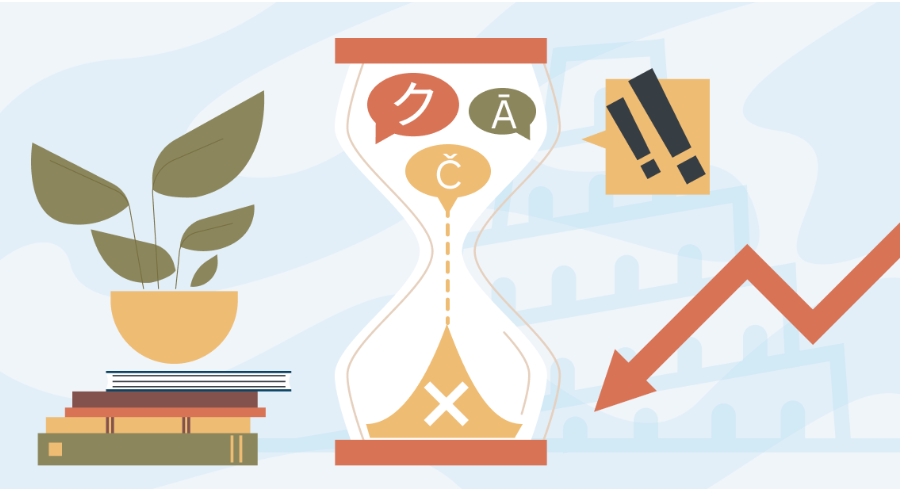
Every fourteen days, a human tongue falls silent. When a language disappears, people lose more than words. They lose traditions and knowledge passed between generations. Many communities face this risk today. Understanding why languages disappear is the first step toward protecting them.
What an endangered language is
Linguists define endangered language as one that may disappear because fewer people speak it and pass it on to children.
So, what is language endangerment? It is the process through which a language loses speakers and its use declines. Answering the question «How many endangered languages are there?»: UNESCO estimates that at least 40% of the world’s 7,000 languages are threatened with extinction.
Why languages disappear
Social and economic changes can put a language at risk, and these causes often overlap.
Language shift and dominance of major languages
People may switch to a dominant language to find jobs or access education and healthcare. As a result, local languages lose their place in everyday life.
Globalization, migration, and urbanization
When rural speakers move to cities, they often use the language spoken by the wider community. Children may adopt it at school and with friends.
Education policies and social pressure
State schools historically enforced single national curriculums. Classrooms punished children for speaking indigenous dialects. This pressure created deep social stigma for indigenous speakers.
Declining intergenerational language transmission
A language becomes especially vulnerable when parents stop teaching it to their children. Older speakers may still use it, but younger generations may understand only a few words. Eventually, everyday communication shifts to another language.
How endangered languages are classified
UNESCO uses several levels to describe languages disappearing.
| Degree of endangerment | Grade | Description |
| Safe | 5 | Spoken by all generations, including children. |
| Stable yet threatened | 5− | Spoken by all generations, but replaced by a dominant language in some contexts. |
| Unsafe | 4 | Spoken by most children, but limited to certain settings. |
| Definitely endangered | 3 | No longer learned by children as their mother tongue at home. |
| Severely endangered | 2 | Spoken mainly by older generations. |
| Critically endangered | 1 | Spoken rarely by a few people of the great-grandparental generation. |
| Extinct | 0 | No speakers remain. |
When people ask what languages are going extinct, they should remember that language status can change. An endangered language list, such as UNESCO's Atlas of the World’s Languages in Danger, helps researchers and communities identify those at risk.
What some examples of endangered languages are
Critically endangered languages
These are among the most endangered languages and are considered almost extinct languages. One of the examples is Ainu, a language spoken in northern Japan. It became critically endangered after Japanese colonization brought assimilation policies that discouraged its use and forced Ainu children to learn Japanese in schools. As of 2025, only two native speakers were reported to remain, although revitalization efforts are helping new learners study the language.

The Ainu section of the Asahikawa City Museum—Adventure Hokkaido
Languages that have been successfully revitalized
Hawaiian shows that language decline can be reversed. In the 1980s, fewer than 50 children could speak the language. Community members established immersion schools to teach it to younger generations. Today, more than 4,000 students learn and speak Hawaiian daily.
What happens when a language dies
The extinction of languages affects entire communities. A language carries local history and knowledge of the environment. Translation may preserve information but miss the original meaning or cultural context.
Language loss can also weaken connections between generations. When younger people no longer understand their elders, they may lose access to traditional stories and expressions.
Why it is important to preserve endangered languages
A language can tell us how people lived, survived, and adapted to their environment. When a language disappears, this knowledge can be lost with it.
Language is also linked to human rights. People need to understand the language used in essential services, such as healthcare. Without it, they may struggle to communicate with medical staff and get the care they need.
How endangered languages can be preserved
Communities can protect their languages by:
- Teaching children through family conversations and language immersion programs.
- Recording native speakers and documenting stories, songs, and vocabulary.
- Creating dictionaries and books.
- Supporting local media and cultural events that use the language.
These efforts work best when speakers guide the process and decide how their language should be taught and shared.
Conclusion
Many dying languages in the world face pressure from dominant languages, social change, and declining use. Thousands of languages are at risk, but revitalization is possible.
Protecting an endangered language takes time and community support. When people use it in homes, schools, and everyday life, they give it a better chance of surviving for future generations.
Recommended content

Subtitles vs. Captions: What’s the Difference?

What Is Data Annotation for AI? A Guide to Labeled Training Data

Localizing Voice-Overs for Corporate Training: How to Choose the Right Accent and Tone