What Is Back Translation?
When global companies enter international markets, ensuring the precision of their localized content is a top priority. In sectors where misinterpretation can lead to legal disputes, financial losses, or medical hazards, standard proofreading is often insufficient. To guarantee absolute precision, organizations rely on a rigorous quality assurance method known as back translation (or reverse translation).
But what is back translation exactly? Experts in the field define back translation as the process of taking an already translated document and translating it back into its original source language. This second translation is done by an independent linguist who has no prior knowledge of the original text.
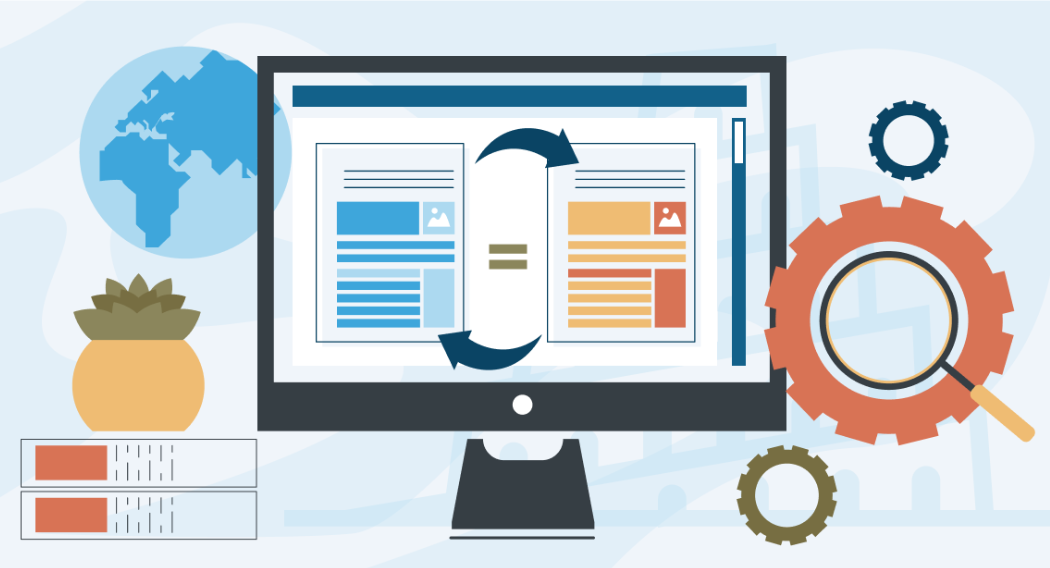
By placing the newly generated back to back translation directly alongside the original text, project managers and compliance officers can evaluate whether the core message has suffered any distortion or omission. It serves as a form of quality assurance (QA) for high-stakes content, ensuring that the translated text aligns perfectly with industry compliance standards.
How does back translation work
The back translation method is a highly structured process that typically follows three key stages.
Step 1: forward translation
The process begins just like any other localization project. The original source text is handed over to a professional translator who specializes in the relevant subject matter. This linguist translates the text from the source language into the required target language, strictly adhering to the project's style guides, terminology requirements, and other guidelines.
Step 2: reverse translation
Once the forward translation is completed, the target-language file is handed over to a completely different, independent translator. This linguist must perform a reverse language translation back into the original source language. To maintain total objectivity, this second translator works completely “blind.” They are granted zero access to the original source text.
Step 3: comparison and reconciliation
During this stage, the reviewer compares the original document side-by-side with the new backward translation. They look for any discrepancies in meaning, context, or terminology to evaluate the overall translation and back translation and log any drifts that can cause issues by type.
It is crucial to note that language is inherently fluid, so a word-for-word mismatch does not automatically mean the forward translation was incorrect. The reviewer must differentiate between acceptable stylistic variations (such as using synonyms) and true semantic errors that change the functional meaning of the text. If any checks fail or reveal ambiguities, the target translation is revised and refined until it is completely accurate.
A simple back translation example
To better understand what is back translation, let us look at a simple scenario involving a user account legal update.
- Original English Text (English): “You can cancel your premium subscription at any time, but no refunds will be issued for the remaining days of the current month.”
- Forward Translation (Ukrainian): “Ви можете скасувати підписку преміум у будь-який момент, але кошти за невикористані дні поточного місяця не повернуться.”
- Back Translation (English): “You are free to stop your paid subscription whenever you want, though money for the left-over days of this month is not refundable.”
This scenario demonstrates a successful quality match where the underlying logic remains completely intact despite natural shifts in vocabulary during the reverse translation workflow.
When reviewers run their final checks and compare the original text with the back-translated version, they will notice several phrasing differences:
- The formal verb “cancel” became “stop... subscription.”
- The legal phrase “no refunds will be issued” shifted to “money... is not refundable.”
- The timeframe “at any time” transformed into “whenever you want.”
Because languages do not map to each other word-for-word, these stylistic variations are acceptable. This comparison gives the project team absolute assurance that the Ukrainian text carries the correct context, making it safe and compliant for deployment.
When is back translation used
This meticulous method is not used for every translation project. Instead, it is reserved for specific scenarios where errors could lead to severe consequences.
- Healthcare.
Informed consent forms, patient questionnaires, and medical device instructions heavily rely on back translation to meet international safety protocols.
- Legal and financial sectors.
Binding contracts, financial disclosures, and protocol documents require absolute precision.
- Regulatory requirements.
Government bodies like the FDA or EMA often require documented back translations as part of the formal approval process for new drug, treatments etc.
Back translation is far less effective for content that prioritizes emotional resonance or deep market adaptation over exact word-for-word accuracy. Instead, this rigid method is reserved for high-risk content like medical, legal, and compliance documentation where absolute factual precision is critical and leaves no room for creative adaptation.
Why back translation matters
The primary back translation meaning lies in its ability to safeguard organizations against catastrophic localization errors. A text can read perfectly well to a native speaker and still drift dangerously away from its original meaning. By using back translation services, businesses can confidently protect their brand reputation and avoid costly regulatory fines.
The effectiveness of back translation is backed by real numbers. Academic research compiled by the UCSF Center for Aging in Diverse Communities shows that this double-check reduces meaning and context errors by up to 60%. It catches hidden mistakes that a regular proofreader might easily pass by.
Furthermore, data from industry specialists at Lionbridge highlights that this method helps achieve a 99% accuracy rate in complex technical terminology. For global businesses, this precision has a direct financial impact. For instance, companies that use this approach experience a 28% drop in product label rejections by regulatory bodies like the FDA.
Limitations of back translation
While highly effective for risk mitigation, relying solely on this method comes with notable drawbacks:
- Time-consuming.
Back translation adds multiple steps to the localization workflow. Because you must hire a second translator to work sequentially, content cannot be published quickly.
- Costly investment.
It essentially doubles or triples the overall translation budget. Clients are paying for the initial translation, the blind reverse translation, and a third specialist to handle the comparison review. These combined fees quickly drain resources if applied to non-essential materials.
- Literal vs. natural phrasing.
Because back-translators aim for a literal translation to show the exact meaning, it doesn't always reflect how natural or culturally appropriate the text sounds in the target language. You wouldn't use this for marketing slogans or creative content where emotional resonance matters more than literal equivalence. For instance, if you type a culturally nuanced marketing phrase into a web engine, a quick search for a call back in Spanish google translate style output will immediately prove that literal translations completely lose context.
Back translation vs. other translation quality methods
Different quality assurance methods provide different approaches to scalability, cost, and speed of the localization process.
| Method | Scalability | Cost | Speed | Main focus |
| Back translation | Low | High | Slow | Accuracy and compliance |
| Linguistic review | Moderate | Moderate | Moderate | Natural flow |
| Automated QA | High | Low | Fast | Grammar, formatting, and punctuation |
Choosing the right approach is about finding a balance between operational efficiency and risk management. While the table highlights the clear trade-offs between these workflows, modern organizations do not rely on just one single method. Instead, teams commonly use a hybrid approach.
For example, a company might deploy fast, low-cost automated QA checks across 100% of its daily content to eliminate basic formatting and punctuation errors instantly. At the same time, they will run high-risk materials through a manual linguistic review or reserve the back translation method for files that face strict regulations.
Is back translation enough to ensure translation quality?
While back translation is unmatched at catching factual discrepancies, it is rarely enough on its own to guarantee good translation quality. It must be paired with other quality assurance steps. This method is a specialized tool for finding errors, but it is not a complete quality strategy.
The main reason is that a reverse translation focuses entirely on literal accuracy. It cannot tell you if a sentence sounds natural or culturally appropriate in the target language. A document can pass a reverse literal check perfectly while still sounding stiff, robotic, or incredibly awkward to a native speaker. Back translation ensures the text is safe, but it does not ensure the text is good.
For comprehensive brand protection, companies should integrate professional language translation services that utilize translation memories, glossaries, and editing. This ensures that while meaning is verified via back translation, the final text also reads naturally and matches the corporate tone.
When should you use back translation
Decision whether to deploy a backward translation method depends entirely on the content type and industry rules. Businesses should analyze the direct impact of potential errors before choosing a workflow.
One should definitely use it when dealing with high-risk materials, medical documentation, legal contracts, or when regulatory compliance makes it non-negotiable. These situations require zero compromises on text safety.
On the other hand, back translation should not be used for high-volume, low-risk content like customer support articles, daily blog posts, or creative marketing campaigns, where standard human editing and automated QA tools offer a more scalable and cost-effective solution.
Recommended content
Translation vs. Transcription: What Is the Difference?
What Is Transliteration? How It Differs From Translation and Transcription
What Is a Lingua Franca? Meaning, Examples, and Common Uses
How Many Languages Are There in the World?