What Is a Language Family? Major Language Families Explained
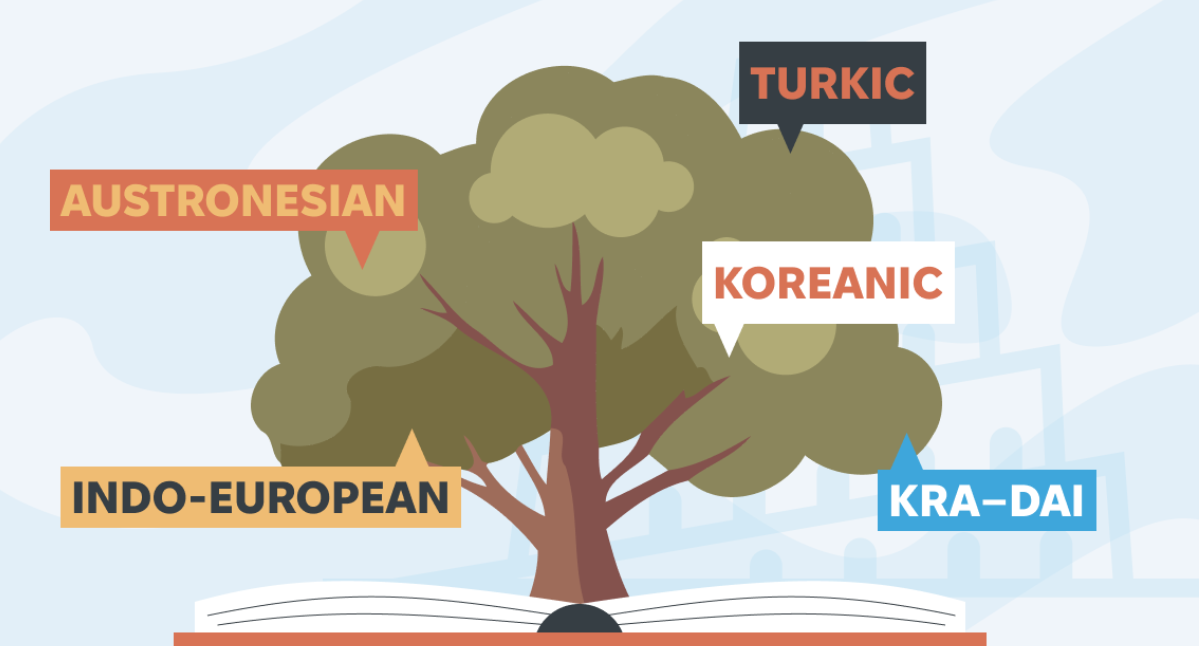
What is a language family?
A linguistic family is a group of languages that developed from a shared ancestral language, known as a proto-language. In historical linguistics, researchers establish this relationship by comparing systematic similarities in vocabulary, grammar, sounds, and other features that are unlikely to have arisen by chance.
So, how many language families are there in the world? There is no single universally accepted number because different linguistic databases use different criteria for defining a family, classifying a language, and distinguishing languages from dialects. For example, Glottolog 5.3 currently classifies 7,674 spoken first-language languages into 246 families. Some languages are also treated as isolates rather than members of larger families, and new historical-comparative research can change established classifications.
How do linguists determine if languages are related?
Linguists determine whether related languages share a common ancestor by looking for systematic patterns rather than isolated similarities. They compare basic vocabulary, grammatical structures, and sound systems, searching for regular correspondences that recur across many words. If similar words follow consistent sound changes, this can provide evidence of a historical relationship. Researchers also consider whether similarities could have resulted from borrowing, especially between languages that have been in prolonged contact.
This process is central to language genealogy, which traces how languages developed and diverged from earlier forms over time. Linguists use the comparative method to reconstruct possible ancestral languages, or proto-languages, and organize their descendants into branches and families. The more consistent the shared innovations and sound correspondences, the stronger the evidence that two languages belong to the same language family.
What is the difference between a language family, branch, and group?
A language family tree shows how languages are classified according to their historical relationships. A language family is the broadest category: it includes languages that descend from a common ancestral language. Within a family, language branches represent major subdivisions that developed as related languages gradually diverged. For example, the Indo-European family includes branches such as Germanic, Romance, and Slavic, each containing languages with a more specific shared history.
The terms language family groups, language groups, and branches can sometimes be used differently depending on the classification system. Generally, a group refers to a smaller set of closely related languages within a branch, while a branch covers a broader historical division. This hierarchy helps linguists describe language relationships at different levels—from a large family to increasingly specific groups—without suggesting that every classification has universally fixed boundaries.
What are the major language families?
The language family definition refers to a group of languages that share a common ancestral language. Among the major language families recognized by linguists are Indo-European, Sino-Tibetan, Niger-Congo, Afro-Asiatic, Austronesian, Dravidian, Turkic, and Uralic, although classification systems differ in how they define and subdivide these groups.
The largest language families can be compared in several ways, including the number of native speakers, number of languages, or geographic distribution. Indo-European is particularly notable for its large population of native speakers. Austronesian, meanwhile, contains more than 1,000 languages spread across a vast area of the Pacific and Southeast Asia. These differences show why there is no single definition of what makes one language family "largest": the answer depends on the measurement used and the classification system applied.
| Language family | Examples of languages |
| Indo-European | Ukrainian, English, German, French, Spanish, Polish, Hindi, Persian |
| Sino-Tibetan | Chinese, Burmese, Tibetan |
| Afro-Asiatic | Arabic, Hebrew, Amharic, Somali |
| Niger-Congo | Swahili, Yoruba, Zulu, Igbo |
| Austronesian | Indonesian, Malay, Tagalog, Māori, Malagasy |
| Dravidian | Tamil, Telugu, Kannada, Malayalam |
| Turkic | Turkish, Kazakh, Uzbek, Azerbaijani, Tatar |
| Uralic | Finnish, Hungarian, Estonian, Sámi languages |
| Kartvelian | Georgian, Mingrelian, Laz |
| Japonic | Japanese, Ryukyuan languages |
| Koreanic | Korean |
| Eskimo–Aleut | Inuktitut, Yupik, Aleut |
| Austroasiatic | Vietnamese, Khmer, Mon |
| Kra–Dai | Thai, Lao, Zhuang |
| Nilo-Saharan | Kanuri, Maasai, and other African languages |
What languages are not part of a language family?
Some languages cannot currently be shown to belong to any established language family. These are known as language isolates—languages for which linguists have found no conclusive evidence of a common ancestor shared with another living or known historical language. Well-known language family examples include Basque in Europe, Ainu in Japan, and Korean, although the classification of some languages remains debated. Being an isolate does not mean that a language has no history; it means that its genetic relationship to other languages has not been demonstrated convincingly.
A language may also appear independent because the evidence needed to establish its language family has been lost or remains insufficient. Historical records can be scarce, and extensive contact with neighboring languages can make older relationships difficult to identify. For this reason, linguists distinguish between a language that is demonstrably unrelated to other known languages and one whose language family examples have not yet been established.
Can languages from the same family be very different?
When speakers of an ancestral language become separated geographically or socially, their speech gradually changes in pronunciation, vocabulary, grammar, and sentence structure. Over many centuries, these changes can produce distinct linguistic groups and even languages that are difficult for speakers to understand without learning them. English and Hindi, for example, may look very different today, but both belong to the Indo-European family and share a distant common ancestry.
The opposite can also occur: languages from different language families may become similar because their speakers live in close contact. Borrowed vocabulary, shared grammatical features, and prolonged bilingualism can create similarities that do not indicate common ancestry. This is why linguists distinguish genetic relationships from similarities caused by language contact.
Why do language families matter?
Studying the language families of the world helps linguists understand how languages developed, spread, and changed over thousands of years. By identifying shared ancestry, researchers can reconstruct earlier forms of speech and trace historical connections between populations and regions.
Language families are also important for understanding cultural and historical diversity. The distribution of the language families of the world reflects migration, geographical separation, trade, and long-term contact between communities. For educators, researchers, and language preservation efforts, family classification provides a useful framework for documenting endangered languages and understanding their relationships with other languages.
Conclusion
Understanding language families helps explain how languages developed, changed, and became connected across different regions and communities. The distribution of language families reflects patterns of migration, cultural contact, and historical development, while also showing the remarkable diversity of human communication. Although linguists cannot always establish every language relationship with certainty, studying these families provides a valuable framework for understanding the history and evolution of the world's languages.
Recommended content

Human-in-the-Loop (HITL) in AI Translation: Why Humans Remain Essential for Brand Content

Translation Management Systems Explained: How to Choose the Right Solution for Your Business

Biased Language Explained: How It Affects Translation and Global Communication

Translating Fintech & Crypto Content: Navigating Emerging Terminology and Compliance